Showing posts with label Paganicon. Show all posts

Saturday, March 25, 2023

Paganicon 2023 - Thoughts and Impressions


The last time I attended Paganicon, in the Twin Cities, MN, was in 2017. At that time, I was living in the northern suburbs and was able to drive and take in some classes and meet folks, but I didn’t plan on staying at the hotel. I only went for a couple of days, did some impromptu book signing because my first book in the “For Witches” was in print. I presented the lecture on the Egyptian Mysteries of the Dead, namely on the contents of the Am Duat with a PowerPoint lecture slide deck. You can read about it here, since I did do a write-up on it for my blog. Needless to say, that was the last time that I attended the convention. I was working and traveling during the following year, and then moved to Virginia. I really couldn’t find the time to make a return visit in 2019, and then the pandemic came in 2020.

During that interlude, I wrote and published two more books with two more manuscripts ready for whenever Llewellyn can put them into production. It was a busy time, but I thought that it would be nice to return this year now that the pandemic has become an endemic disease, more or less. I got emails about what was happening, but I didn’t pay much attention to them. I know that the year 2020, the convention was canceled, and in 2021 it became remote access attendance kind of event, and in 2022, it started to return to a normal convention. Because I had two more books in my series, I felt that it was time for me to return. So, I sent in a lecture request, signed up and then made all of the arrangements to travel to Minneapolis and attend the convention. I also wanted to see the many friends and associates that I had left behind and soak up a bit of the social scene with my pagan tribe. 


Overall, the trip was a big success, although I had to endure a very cold wintry spring, with temperatures nearing zero degrees F. It was very cold, icy and snowy outside, but at the convention center, it was warm and inviting. I had a mini lecture on the nature of a talisman and how to make one at the Llewellyn hospitality suite, and I had a main lecture on the Temporal Model of Magic and the importance of time for celestial types of magical workings. Both went well and were decently attended. I had 25 attendees at the main lecture, because I used up all of the handouts that I had made. My lecture was unfortunately scheduled at 9:30 AM CDT on Sunday, the morning after the ball and extended parties. Those who made it in to my lecture were serious about the topic, regardless of the lack of sleep. Still, the lecture was a success and I even went off script and that made it even better.

While represented my own contribution to the convention, I also attended a number of lectures, and particularly enjoyed those presented by Andras Corbin-Arthen, the found and director of EarthSpirit community, and Kristopher Hughes, chief of the Anglesey Druid Order, a native of Wales and an impressive author. Both of these men presented their own perspective on what could be called a kind of survival of indigenous European paganism. Paganism has survived in obscure rural pockets in Europe, or as in Wales, it has been reconstituted as an integral part of the national culture. Andras, who was born in Galiza in northern Spain, encountered a couple practicing an authentic indigenous form of Witchcraft from the highlands in Scotland when he was a young man and studied with them for over five years. While Andras has deepened and developed his training, and also traveled over much of Europe to discover more remnants of paganism, Kristopher was favored with a cultural foundation for a pagan and magical heritage, revitalized in recent times.

What I learned from these two remarkable men in their lectures is that paganism and witchcraft as practiced by these surviving pockets of Europeans has much in common with other indigenous non-Christian traditions, like the Native American religious practices. There are common threads to all of these groups, and these commonalities can help us modern pagans and witches to be more authentic in our beliefs and practices. Both men showed that it is very important for any pagan religion to include a cultural perspective along with their religious practices. Universal faiths, such as Christianity and Islam, proclaim to be beyond culture or locality, but paganism is dependent on both culture and locality in order to fully function. Witchcraft or paganism are poor faiths if they are stripped of their culture and locality, which was something made abundantly clear in the teachings that Kristopher presented to us at Paganicon.

So, what I learned at this Paganicon was quite illuminating. I learned the following important concepts.

  • Paganism or Witchcraft, even as modern practices must have the following qualities.
  • Culture - a style of life based on older precedents, whether through emulation of actual pagan survivals, reconstructed or developed with available cultural tropes.
  • Location - a typically rural location occupied for centuries with mythic associations, or elected special topographic places where myths are developed, shared with others and passed on.
  • Language - an actual language (Welsh, Gaelic, Celtic, Nordic, Germanic, Saxon, etc.) or a specific terminology (borrowed from other languages or academia) to describe states of consciousness, compose invocations, hymns and incantations, names of magical objects and themes, various beings, deities and demigods, and place names.
  • Folk Practices - rituals, ceremonies, songs, life event rites and celebrations, lunar and solar cycles, recipes for food and drink, special clothing, special decorations, and folk magic.

Some of the qualities that Andras discussed about what these pagan survivals had in common was even more striking.

  • Lack of deities - especially anthropomorphic gods and goddesses. These often assume the guise and nature of animals with only a kind of archetypal representation.
  • Belief in an unifying mystery or web connecting all things together into union - a living tapestry where all things appear as one united design. This one-ness has no name, other than naming it “Mystery”.

The word pagan comes from the Latin pagani, which means rural inhabitant, as opposed to the urbani, folks that live in the city. Pagani was also considered a kind of insult, similar to “country bumpkin” or “red neck”. When the Christians later called the Roman polytheists pagani, this considered quite a powerful insult.

Some of the important guiding points that Andras gave the modern community of Witches and Pagans in the U.S., was to make a conscious break with the underlying culture that promotes capitalism and the exploitation of people and resources, and to build a truly polytheistic culture to underlie our religious and magical practices. We should develop a common language to discuss what we are experiencing and what we believe to ensure better communication and reduce the confusion that an unsupported language might give to a group of people committed to acting outside of the Christian culture. I will have to consider these guiding points, and I am not certain that I agree with them all.

Additionally, it is a sign of extreme foolishness to engage in attacking or discriminating against other pagan or witchcraft traditions when we have more in common with each other than with other faiths that are fundamentally inimical to our practices.

It was an excellent Paganicon pagan convention, and it was probably one of the best that I have ever attended. The Pantheacon convention had its anthropologists and academics giving college level lectures, but that convention is no longer available. We still have Paganicon, and it is good to see that it is evolving and able to present good information to the community at large.


Frater Barrabbas

Wednesday, March 20, 2013

Afterthoughts - Paganicon 2013

A Bitter Cold Vernal Equinox to you, too.

 Well, I made it through another Paganicon, although this year my attendance was very brief compared to last year. I didn’t get a room at the hotel, and I was only able to stay a few hours on Saturday and Sunday. Weekends are usually the only quality time that my girlfriend and I have together since she started her clinical training in a town that is a two hour drive south from our home. Also, I had other responsibilities to attend to, such as getting back to feed and let out our dog. As long as Grace is undergoing this educational process, my ability to go on any extended trips is quite limited. The weather was also pretty odious, even for the Twin Cities, and it was yet another factor. I have never been a big fan of the northern winters, and this year my patience has been really taxed.

I only got to attend one workshop besides my own, and that was one presented by Brandy Williams on the topic of “Pagan Theurgy,” which also covered a brief history of Neoplatonism. I missed out on Orion Foxwood’s workshop, “Candle and the Crossroads” because of a need to tend to some mundane concerns. I managed to sneak in and get around 10 minutes of his talk, but then didn’t want to disturb the talk by trying to go back, and by then it was nearly over. I also got to talk a while with Brandy and share some thoughts and ideas about magic, occultism, Thelema and being a part-time author. I didn’t get a chance to chat with Orion, which was disappointing. I would very much like a chance to chat with him, but there have been few opportunities when we have met previously, mostly at Pantheacon. He is an inspirational individual, and I have many questions to ask him and topics of mutual interest. Perhaps some day we will get that opportunity, particularly if I continue to make myself available for gatherings.

Brandy Williams is quite an excellent author and writer. I have secretly modeled my literary ambitions after hers, and I have often admired her, at least from a distance. So she has kind of functioned as a role model for me, starting out as an Immanion author and continuing to write and publish for other publishers as well. I was very delighted to spend some of my precious time talking with her about various subjects. Her approach to magick, paganism and occultism is nothing short of inspirational. I got a number of ideas and thought provoking insights in my mind just from attending her class on Theurgy. I was happy to acknowledge to myself that the system of magick that I use has all of the points of Neoplatonic Theurgy amply covered, including statue animation. It appears that a number of us are getting very deeply into Iamblichus and the writings of the late pagan Neoplatonists, knowing that they represent the point in time where we should pick up their work and continue moving it into the far future.

I got to tell her that my pet idea is that the Indian esoteric philosophers of the golden age of Indian culture, which occurred as Rome slipped into the dark ages, seemed to continue on where the Neoplatonic philosophers had left off in Harran. Where Iamblichus stated that the human soul can never be of the same substance or level of being as the Gods, the discipline of Advaita Vendanta showed that the Godhead in every man and woman is commensurate with the absolute Godhead (“there can be no difference between Brahman and Atman”). I sense that there is a continuity of the esoteric strain of philosophy from Europe, to Harran, and thence, to India, where it continued to thrive and grow. Perhaps we in the West can finally complete Neoplatonism by considering Indian esoteric philosophy to be its crowning achievement. I will have to think more about this interesting insight. 

Lunch on Saturday was spent with my friend Steven Posch who I consider to be one of the living pagan treasures in our community of Paganistan (a term he has famously coined). He is a pagan poet of great renown, an excellent public liturgist, rabble rousing Jewitch and all around excellent gadfly. He is also avidly pursuing the secrets of the late demise of Baltic paganism only recently becoming available to the west, and in this area, he is acquiring a great deal of authentic pagan lore, ostensibly to pad out his own particular linage and witchcraft practice. He’s one of the few who actually knows how to count to 20 using the Witchcraft language. Lunch with Steve is always full of interesting conversation and banter.

My friend Paul Rucker, who is something of an illuminating pagan artist, along with Helda HedgeWalker and others hosted a visual presentation at the Sacred Gallery Space. While Paul was quite busy and I only saw him in passing, the Sacred Gallery was quite an exquisite exhibition of pagan artists. I sat in the gallery, which was a converted suite, for a short while fully galvanized by the beauty and artistry of the paintings and works of art carefully placed over most of the wall space. It was done tastefully and to great effect. I am only sorry that I couldn’t tell him how much I liked and appreciated what he and others had accomplished.

I also got to hang out for a little while with a group of young friends. In talking with them and spending my last lunch with them, I found that perhaps I am not so much a dinosaur as I had thought. In the beginning of my autumn years, I probably do have something of importance to pass on to younger members of my pagan and wiccan community. We will see if I have any relevant thoughts or ideas in the decades to come when I am nothing more than a forgotten monument in some graveyard.

My class was very sparsely attended, but at least those who attended were very engaged with what I was teaching and understood what I was attempting to communicate. They were a bright group of individuals, and they also bought a number of my books as well. I have been selling my copies of MARM volumes 1 though 3 at a huge discount because the MARM Omnibus edition should be coming out in the next few weeks. In the next couple of months I will reprise a more extended version of my Practical Qabalah in Brief workshop at the local occult bookstores and see if more people will be interested in attending. Based on that experiment, I will either move forward with putting together a weekend long intensive workshop, or I will consider the Qablah not be a good topic to try to teach in the Twin Cities.

A final note - my travels to and from the Paganicon hotel were made more precarious by a freak winter storm that happened on Friday. I had to leave quite early Saturday morning to make the 32 mile trip to the hotel, and the roads were not sufficiently cleared to make the trip easy. In my neck of the woods (literally) the roads were hazardous and even the freeway system was not completely clear. Thankfully, the traffic was light, but it was a slightly harrowing trip to get to the hotel in time to deliver my presentation. After that morning trip, the roads were quite clear and bare, even though the weather was quite cold. Here it is nigh on the Vernal Equinox add it feels more like January weather. I have noticed no signs of spring and it is likely that winter will continue well into April, which is not an uncommon thing. Only the brightness and warmth of the sun betrays the lateness of the season, and then it can only be experienced while sitting in a car, where the inside heats up to coatless temperatures rather quickly.

I have to say that I am quite over winter, even though nature hasn’t caught on to my mood or up to my expectations. Such a winter that we have had only makes me long for warmer climates. I guess you could say that I am wishing to leave the Twin Cities and when I have these kinds of impressions, the reality is not too long in coming. I sense that I might just get an opportunity to move somewhere else in the next couple of years. I had not previously felt that way, but I do feel it now. I will take it as a kind of omen and as I have said, time will tell how it all turns out.

Frater Barrabbas

Tuesday, March 12, 2013

Paganicon 2013 - March 15 - 17


The third annual Paganicon will be held in the Twin Cities this coming weekend. The guest speakers are Brandy Williams and Orion Foxwood. I consider both of these individuals to be quite excellent speakers and a real draw for this year’s convention. I am looking forward to catching at least one of their workshops.

I will be giving a short workshop called “Practical Qabalah in Brief” on Saturday, March 16, at 9:00 am. It will last for an hour. I will also be doing a book signing on Sunday, March 17, at 11:00 am. Unfortunately, I won’t have a lot of time to socialize, attend workshops or do some shopping at the vendor’s room, but at least I will have a little bit of time to do some of these things. Scheduling issues, and the fact that my girlfriend will be out of town most of that day will shorten the time that I can spend there. Last year I paid for a room at the hotel for two nights and got to spend a lot of time at the convention. This year, I will be traveling from home both days and I will have to miss out on the Saturday night ball. It will be good to see some friends that I haven’t seen in quite a few months, and to see if the Twin Cities are ready for a real serious examination of the Qabalah. I will also get see if my book “Magical Qabalah for Beginners” has any legs, since I will be bringing some books with me to sell at the workshop and the book signing.

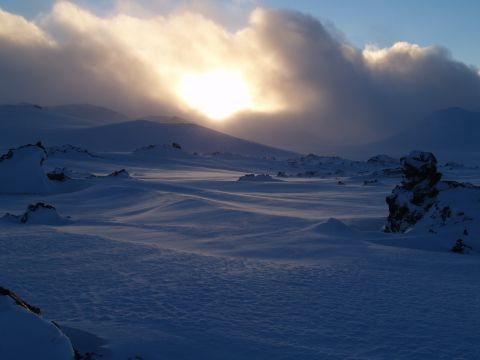
It is now the ides of March, and there isn’t even a hint of spring yet, which is sort of like the picture above. There is some snow melting during the day, but the nights are bitter cold and the melted snow turns to ice. On Sunday it’s supposed to be cold again, with a high temperature of only 19 degrees F. As is typical up here in the frozen tundra, spring comes slowly, and March is still a winter month for the most part. While I seem to licked most of my physical ailments this winter and I have begun to exercise again, I can’t seem to shake the “blues” that I feel because of the cold and heartless winter endures without a sign of going away. Now all I need to do is to get back into my magick, and perhaps then I will once again experience the warmth of Spirit lighten my earthly burdens. (These things always come in cycles, and it is always important to persevere.)

Once the convention is over, I will write up a short article highlighting some of things that I saw and enjoyed. Until then, have a wonderful weekend and stay warm.

Frater Barrabbas

Tuesday, July 10, 2012

Are Pagan Festivals Dead? - Part 1


Introduction

One of the most exciting and thrilling experiences that I have ever had was attending a pagan festival for the first time back in the summer of 1980. It was called the Pan Pagan Festival, and it was held at a rather dreary campground in the northwest corner of Indiana. The campground was shared with a Baptist camp revival, which at least was separated by a small lake. Over 500 people showed up for that event, and all of the big names were there. There was Gwyddion Penderwyn, Z. Budapest, Selena Fox, and many other notables as well.

It was my first outing after having escaped from the Coven from Hell and it was my first experience meeting almost every shade of Pagan and Wiccan. I even met a few members of the left hand path and that was quite amazing. Yes, even a few Satanists managed to attend (but don’t tell anyone). I had just graduated from college and for me this whole venue was an incredible experience. I also got to meet some of the best craft friends that I had ever made, so it certainly was a pivotal event for me and I suspect for many others, too. Yet this event wasn’t very ideal as far as pagan festivals go, since it was over crowded, the campsite was right next to the freeway so you heard vehicle traffic at all hours and we had an uneasy peace with the Baptists on the other side of the small lake.

Other festivals and conventions that I have attended since then were certainly better organized and had much better camping or lodging facilities, but this one was my very first pagan festival, so it will always have a special place in my heart. Now that we are living in the early 21st century, there are many gatherings and festivals that happen every year, whether local, regional or even drawing an international crowd. I have even helped found a pagan festival, which is the Heartland Pagan Festival (started in 1986), and I helped to run it for its first few years. Heartland Pagan Festival is still happening today during the Memorial Day weekend, even after 27 years.

So why am I asking such a stupid question, “Are pagan festivals dead?” Obviously, they seem to be thriving and appear nearly everywhere in the country. What a foolish phrase to use as the title of an article about pagan gatherings! However, as Bob Dylan has said, “The Times They Are a-Changin'” and indeed they are changing with a vengeance. There are many factors that are shaping the future in which we will live and they will probably have a profound impact on Pagans and Wiccans being able to assemble in large groups, unless of course, those groups are local and sustainable in the long term.

We should also examine the relevancy of these gatherings so we can look at them more objectively. Back in the seventies and eighties, it was critically important for us to assemble in large gatherings since it was the only way to communicate (outside of writing letters or talking on the telephone), and we were still forging an overall kind of cohesive identity. Sharing ideas and thoughts in an open, free and chaotic manner helped the founders and key members of various Pagan and Wiccan organizations to clarify and develop their traditions. It also helped us as a group to find a common ground and learn to identify with others who were somewhat or even startlingly different. We learned to be tolerant towards a divergence of beliefs and practices and to respect each other. We also learned to fiercely defend our rights to believe and practice our faith as we saw fit. All this occurred as the encroaching and ever popular fundamentalist Christian organizations gained in political power and popularity, starting in the 1980's.

Still, times are indeed changing and the need for such large gatherings may have achieved the upper limit in terms of both usefulness and sustainability.  By usefulness I am saying that merely getting together for what would seem to be mostly a social gathering with sprinkling of some workshops, presentations, rituals, live music and the selling of obscure books and goods may not represent what is really needed or relevant for our growing population of practitioners and followers. By sustainability, I am thinking of the availability of resources to gather together in large regional or even international groups. Traveling by car or plane does impact the environment with pollutants and it also uses up precious resources, namely fossil fuels. These resources will probably become a lot more expensive in the decades ahead.

It would also be smart for us to consider the impact of the internet on inter-faith communications and social gatherings. What this means is that lots of people can communicate and even engage in one-way (email, blogs and pod casts) or even two way voice and/or video conferencing at a fraction of the cost and trouble of actually traveling to a location to meet and exchange ideas. It’s even possible that some future gatherings might become entirely virtual events. Certainly, this technology is already having an impact on how people communicate with one another, and the relative ease and frequency of those communications.

As followers of earth-based spiritual traditions, we should be sensitive to the issues concerning the use of resources and sustainability. What this means is that in the future, it’s very likely that long distance transportation by car or by plane may become quite expensive, making local gatherings or virtual gatherings more financially attractive and sustainable over the long run. So with that being said, we can at least agree that regional and international gatherings are probably going to become more rare or they might even completely disappear in the future, because only those who can afford the transportation costs would be able to attend. We can assume that the cost of transportation will become a limiting factor for gatherings in the future.

These changes are probably going to greatly affect the way we live and what we eat, the location of our homes and how we travel to non-local destinations. When crude oil becomes far less abundant than it is today (and that is indeed a fact we can bank on), it’s going to become too expensive for individuals and small groups to travel by car or plane, and that more energy efficient systems of mass transit will become the norm for most. We will also see a decline in the kinds of foods that we find in the markets today, so that seasonal availability will once again affect what we buy in regards to fruit, vegetables and even meat, as it did when I was child. The world is facing the immanent reality that human population growth and resource consumption will have to drastically change in the next fifty years or we will face catastrophic repercussions.

Our habits and lifestyles in this country will probably start being impacted in the next couple of decades by these events, as it already has in the third world and to some extent, Europe. We are going to have to become much more “greener” in our approach to life and the use of resources. Pollution and greenhouse gases will also have quite an impact on how we live and we will ultimately be forced into using more efficient transportation systems that will produce vastly less levels of pollution than the average car or plane does now. As followers of earth-based spirituality, we should not only be aware of these facts, but actually embrace them and start planning and acting as if those times were already here.

That being said, I would like to discuss a little bit of history with you and examine the different kinds of gatherings that exist today, their possible origins, and what may still be sustainable in the difficult decades ahead. I also want to discuss what I think is really needed in our communities that is lacking, which would help us to mature our spiritual perspectives and practices, because compared to the other world religions, we are very new and just starting to coalesce our spiritual beliefs and practices.


How Gatherings Evolved and the Three Types of Gatherings

We will now consider three types of gatherings that are currently employed in the Pagan and Wiccan communities. This, of course, doesn't include local community gatherings or sectarian gatherings that would occur for a single day or night.


The Pagan Convention

The very first kind of gathering that occurred for pagans and various other kinds of religious groups of that ilk was probably a gathering that was not really intended for them in the first place. That was the Science Fiction convention, which was expanded to include the genre of fantasy writing, and this, of course, brought together science fiction geeks with fans of alternative worlds of magic and wonder. It was also the most frequented watering hole for quite a number of the budding pagan revival groups as well.

Science fiction as a literary body has produced a least one very well known religious organization, and that is Scientology; founded by the science fiction author and occultist, L. Ron Hubbard. (I will forgo talking any more about that topic.) Science fiction and fantasy novels, such as “Stranger in a Strange Land” by Robert A. Heinlein was responsible for the founding of the Church of All Worlds, and Tolkein’s Ring series certainly spawned all sorts of creative endeavors that attempted to bring a degree of reality to stories that were mythic, timeless and enjoyed by many. Scifi Cons, as they are called, spawned other gatherings as well, not to mention the huge following for comics and comic heros (Comicons), Star Trek, and numerous others.

Probably the grand daddy of them all was the electronic consumer convention, which was based on other kinds of gatherings, such as political party conventions.  It’s not surprising then that some of the first gatherings of pagans may have occurred at some of these conventions, and that they naturally would have used the model of the fan or consumer convention as a format for a strictly pagan kind of convention. There are at least a few pagan conventions that happen every year, and these tend to draw a more international audience. They are also less formal and much more public.

The critical element for planning a convention type of gathering is to first find a hotel that will accommodate a large gathering of like minded people. There should be meeting rooms, conference rooms and even large halls for larger congregations of people to enact rituals or musical concerts in a large public setting. It’s also critically important to be able to publicize such an event so that a large group of people will attend, enabling the hotel to book the hotel rooms in advance and make a profit from the gathering. The key is getting enough people together so that the gathering will be able to meet its expenses. This requires a fair commitment up-front to the hosting hotel from those putting on the gathering, and it’s necessary to be able to spread the word so that enough people will attend. 

If a convention doesn’t get enough people, then not only will the organization that attempted to host it probably go broke, but some individuals will likely be responsible for the out-of-pocket unmet costs for the organization, the hotel and any other parties supplying food, vending or other services. So this kind of gathering is risky and is better served in areas with a large population, such as large cities or metro areas.

The pros for such a gathering are numerous, such as providing a safe and comfortable venue for people of like mind to socially meet, network, put on discussion groups, workshops, sell obscure or hard to find products and generally have a good time eating and drinking with fellow Pagans and Witches. Successful conventions are usually located in dense transportation hubs, so they are easily accessible and can accommodate large fluctuations of people coming and going.

The cons for such a gathering are also numerous. First, in order to be sustainable, conventions must attract a large group of people, and that means that anyone in the general public who is willing to pay the entry fee are able to attend. Often, hotels are accommodating more than one gathering or convention at a time, so there is a mix of various attendees and other folks who happen to be there at the same time. Seldom is a hotel exclusively held for a specific convention. Even the largest ones, such as Pantheacon, which is held outside of San Jose near the local airport, have to share some space with outliers. Smaller conventions would have to share resources with individuals who are not into Paganism or Wicca, and who may find the whole event to be annoying or even obnoxious.

Hopefully everyone will be patient, tolerant and get along when rubbing elbows together in the hotel lobbies, hallways and at the local eateries and restaurants; but that doesn’t always occur. There’s always the possibility of some kind of problem developing even between attendees who are supposed to be peacefully meeting and greeting other folks of the same or similar persuasion. Perhaps that’s why Pantheacon bans the carrying of actual weapons or magickal tools on the premises. Large groups also means that there is little privacy and absolutely no control over who attends, not to mention the appearance of the local press and other gawkers or unwanted spectators. These events are also shorter than other kinds of gatherings, typically lasting over a long weekend. This is because hosting a convention that lasted a week or more would be too expensive and couldn’t attract enough people to make it financially feasible.

I suspect that the convention model for gatherings will probably occur for some time in the future, so long as large groups of individuals can afford to travel to regional metropolitan locations. However, certainly the attenuation in fossil fuels and the expenses associated with energy and food consumption will take their toll, and it’s quite possible that conventions will become less attended and eventually fold, particularly pagan conventions. These may even become events that are planned once every few years or even once a decade, ensuring that many people will be able to plan and save up their money to attend. Yet one of the major drawbacks to this kind of gathering is the fact that there isn’t much privacy outside of one’s hotel room. It’s also not a good venue for sharing intimate spiritual experiences and performing deep and involving workings in small groups outside of the privacy of one’s room.

(To be continued..)

Frater Barrabbas

Monday, March 19, 2012

Adventures at Paganicon 2012


All Snakes Day

Paganicon occurred over the weekend, and I fully attended and engaged in the various planned and unplanned activities. Overall, I would say that this pagan convention has turned out to be quite good. There were 50% more people attending this year than the previous year, and folks from as far away as Indiana and Winnipeg, Canada, attended. I also made some new friends, restored connections with some old friends, and basically had a good time. The weather over the weekend was quite warm for this time of year, and I am sure that some new record highs have been registered. Last year it was pretty cold outside with many traces of winter still visible, yet this year there was no indication that winter was even active. Gone was the snow and ice, and the temperatures were in the high 70's, which is very strange for the Twin Cities in mid March.

My two back to back classes on the Qabalah were initially fairly well attended. I expected a maximum of 15 attendees, and that’s how many showed up. However, after the first hour, all of those attendees except two departed to attend other classes, and most of them went to see Christopher Penczak’s class on Ascension Magick. I can’t blame them for departing, of course, and I quickly discovered that I had far more material to present than I had time to present it. Each section took longer to complete than I had anticipated, so what I was able to present to the attendees was a partial introduction instead of the whole thing. Also, considering that most of the people left after the first hour was up meant that there wasn’t enough ground covered to really segue into the next section. So the remaining two attendees and I engaged in conversations about some of the rest of the material, and I answered a number of questions.

This was the first time that I had attempted to present these two classes, and considering that they will be incorporated into an 18 hour three day intensive, I am not too worried about re-sizing them or scaling them down. Instead, I will seek to break them into sections and expand them so they will be fully vested with all of the information that I would want to present in a much larger format. So, I was satisfied with the overall results of the two presentations, and I did learn something about how much time I will need if and when I present the full weekend intensive. Some of my attendees gave me good feedback and told me that they are looking forward to the new book that I will be publishing via Llewellyn in March of 2013.

Christopher Penczak was the main speaker for Paganicon, and I must admit that I was completely unfamiliar with any of his writings. I’ve seen his books in the book stores, and it is fairly obvious that he is a prolific writer with many books in print. Christopher has put together a complete system of witchcraft, publishing his books in series of instruction manuals regarding his Temple of Witchcraft system. I attended his Friday night class on the Three Rays of Witchcraft, and I found his class to be quite engaging and interesting. What became apparent to me is that Christopher has managed to successfully pull together some pretty amazing and radically different philosophies into the revised foundation of witchcraft. I have always maintained that modern witchcraft is fairly incomplete, and that in order to make it a more comprehensive system of spirituality and magick, one would need to fill in the holes using other sources.

What Christopher has done was to pull in sources of occult and spiritual lore that I wouldn’t have chosen, being either unfamiliar with them or at least felt that they wouldn’t work together. These disparate sources include Reiki, Theosophy, the Alice A. Bailey teachings, other various New Age sources (Ascension), as well as pagan Druidism, ceremonial magick and the Qabalah. At first glance, these very difficult occult systems might seem to be contradictory and incapable of being blended or merged together, but Christopher has managed to artfully merge them together as if they were meant to be worked as one overall system. I found his way of moving seamlessly from one system to another without any jarring contradictions to be quire remarkable. Still, from my own experienced standpoint, I wouldn’t employ very many New Age systems in my own revised and developed tradition simply because I would find such a syncretism to be inelegant and esthetically unappealing. That’s just my personal opinion and tastes in occultism, and they in no way negate what Christopher has accomplished. In his thoroughness, he has given birth to a comprehensive system of spirituality and magick, and all of it is based on a foundation of witchcraft. I found that to be both attractive and compelling, and I saw that others who were attending his lectures and rituals found it attractive as well.

The Three Rays of Witchcraft are, of course, based on the first three Rays of the Seven Ray system of Theosophy and the Bailey teachings (being the Red, Blue and Yellow Rays). Christopher merged the concept of these three rays with the traditional witchcraft (Clan of Tubal Cain) concepts of the three paths of the straight, the bent and the crooked, which he had perceived through a three-fold ray vision, where the three rays emerge from a common point or source. This theme is well established in Christopher’s book, Three Rays of Witchcraft, which you can find here. However, one point that he made in his talk that I found very illuminating is where he discussed the origins of his vision, and that it represented how many seekers have approached a more comprehensive practice of witchcraft - or for that manner, any system of occultism.

According the Christopher, most practitioners are inveterate eclectic collectors of many diverse and often different and divergent techniques, philosophies and ritual lore. He compared it to a totemic magpie collecting shiny bits that it steals while it browses around for food and novelty items. These attractive baubles end up in the magpie’s nest, and after a time, the nest is full of completely unrelated, shiny and colorful junk. Occult eclecticism is the disease of the inveterate collector, and often times what is collected might seem important, but ultimately, in order to become an integral part of one’s personal spiritual or magickal discipline, it must have both relevance and some degree of relativity to the rest of one’s regimen.

Often this process of making a unified system out of a lot of disparate parts is to first begin to order them in some manner, perhaps to extend the analogy of the magpie, this act of creating order would be to formulate a collage or a mosaic out of these various seemingly unrelated elements. This effort at finding unity in diversity is very important, because the mere fact that one is manipulating powerful spiritual symbols and philosophies will trigger a visionary event where the structure and image of a meta-system will be revealed to the seeker. For me, this meta-system was the Tree of Life, for Christopher, it was the Seven Rays. Later on, he was able to find a synthesis between the Seven Rays and the Tree of Life, and all this could be accomplished due to the unifying vision that he had of the Three Rays.

I found this obvious biographical trope about how Christopher himself was able to merge several unrelated occult systems together into a unified system (the Temple of Witchcraft) useful in my own discussion of the importance of using a kind of meta-system to order and organize the various collected systems and methodologies of the practicing occultist, and that this action of ordering will have a profound effect on the seeker. It was true with me, and it was also true for Christopher Penczak, so in a sense, our approach to crafting a unified system are very similar. In some ways, his story corroborates my own, and it lends greater power to the idea that working with the symbols of the Qabalah as if they were dynamically alive is the key to making it truly a powerful system of occultism. Without this approach, the Qabalah is nothing more than a glyph and a bunch of tabular lists, along with some very arcane lore about creation, cosmology and the final dissolution. Making it come alive is the whole key to empowering oneself and being able to use the Qabalah as a metaphysical system in the study and practice of magick.

Saturday night was the “All Snakes Day Ball,” which was a costumed ball. Since I had too little sleep the night before, and I had to help out with the security for an hour, I missed some of this soiree, but what I did see was quite amazing. The cash bar was a bit steep in price and the selection of available drinks limited, but overall, the ball room was well decorated and well attended. I ducked out a bit after 10 pm and went back to my room to crash, but the dance continued until midnight.

Sunday is when I took part in a panel that discussed the organization and presentation of the four public Sabbat events that had been held in 2011 under the aegis of NordCog, a local pagan organization (Northern Dawn and Covenant of the Goddess). On the panel were three of the presenters, the artistic director (Paul) and the presiding leader (Steve). The panel turned out quite excellent, and that was the end of my involvement in the Paganicon pageantry. I did attend a really good class on Helenic Polytheism put on by Cara Schultz, which was scheduled before my panel. Cara focused on the rites and practices that would have been performed in the home during a typical lunar month, and how those beliefs and practices are deployed in the modern Greek pagan household. The class was short, succinct and highly informative. I thought that Cara did an excellent job of presenting her beliefs and practices.

So I gathering my things, made some final shopping transactions, and drove home from the convention, quite satisfied with the whole event. The temperature was almost 80 degrees outside, so I had the window down while I was driving. I got home tired and sweaty, and was amazed at the very weird weather that we were having for a mid March day. If there were any doubts about the impact of climate change, then perhaps how this winter has turned out should allay any doubts whatsoever.

Needless to say, I think that Paganicon was a tremendous success, and it will be interesting to see if it is sustainable. I am already thinking about next year’s convention, when I will have a new book out in print, and be focusing on marketing myself as a knowledgeable Qabalist.

Frater Barrabbas

Sunday, March 4, 2012

Ides of March - Bitter End of Winter


After having a rather mild winter with little snow, we got buried with half a foot of snow on the very last day of February. There has been some additional snow adding to what we already had, so it looks like a very wintry landscape right now. The beginning of March always looks like this even though it’s supposed to be the month when the Vernal Equinox occurs (not to mention St. Patrick’s Day), but that’s the way it is, living up here in Minnesota. Winter has a tendency of lasting from now until the middle of April, but I am hoping for an earlier reprieve.

Meanwhile, as the months have been slowly ticking away through the long period of winter, I have realized that I have still have a mountain of work to do, and less time to do it if I am to have any kind of outdoor life when summer finally does come. I have to admit that sometimes I am an inveterate procrastinator, and other times I can waste a lot of time reading some pulpy fiction book, occupying my thoughts over some pointless political blog or watching too much television. I guess it’s time to bring some discipline to bear on myself and start working more tirelessly on the many projects that I have in front of me. Getting seriously ill with the flu in the last few days has shown me that I don’t have time to burn, and I need to renew my efforts in getting things done before the winter months are over. (So much to do, so little time, really, to do it all - it’s the story of my life, and everyone else’s too.)

Luckily, I was able to perform a very condensed version of the Talismanic Elemental process allowing me to generate the first of three talismans for the Portae Lucis working. At least that ordeal is more or less on schedule. I have other magickal workings that I would like to perform in the weeks and months ahead, and I have made little progress in getting them done. I guess I will have to redouble my efforts.

With the advent of Spring also comes the annual Paganicon convention, which is a newly started pagan gathering in the Twin Cities. I have elected to present two classes on the Qabalah, and the schedule has recently been posted. My two part lecture will be presented back to back, so I will have a time slot of approximately 150 minutes to present an introduction to the basic theory and cover the various aspects of the practical Qabalah. Unfortunately, my class is competing against a well known local celebrity and also the key note speaker. My classes also will be starting at 9 am Saturday morning (March 17), so we’ll see how many folks show up to my lecture series. You can find the schedule here, on this web site.

I must admit that I haven’t put these classes together just yet, but considering that I have a mountain of material produced from doing my book research, it shouldn’t be too difficult for me to assemble a class on the theory and practice of the Qabalah. I have already put together a class outline, so all I need to do is to fill it in. I will usually build up the lecture notes for the lecturer, and produce some class notes to hand out to the attendees. I can say without any trepidation that I truly know this material inside and out. My task will be to communicate this material in a manner that is compelling, interesting, and perhaps even amusing. What I will have to avoid at all costs is to be boring, redundant, or pedantic. I will need to have passion when I am expounding from the lecturne, so that means that I will have to drink a fair amount of coffee and be wide awake when 9 am roles around.

So far, though, the class notes are coming together pretty well, although I am just in the starting stages so far. Here’s a quote from the definition of the Qabalah. What do you think of that? Does that sound interesting? Hopefully, it will be interesting when I present it in a couple of weeks.

“In the Qabalah, truth is believed to be obscured, hidden and unknown to common humanity. Thus, the Qabalah is an esoteric doctrine that uses systems of analysis to determine the nature of these hidden truths and reveal them. Causal connections (between things) are considered to be absolute - they are found everywhere. Therefore, everything is connected to everything else, and all connections are meaningful and significant. If, by extension, everything is connected together, than at some point there is a place where that unity can be resolved into a singularity - where the All can also be revealed to be the One.”

I think that I am off to a good start on the class notes. I’ll share some more material from them in the near future.

***

After an incubation period of more than three days, I went and examined the Solar talisman that I had generated in my working on last Tuesday. I was very pleased with the results, I must say. I picked up the talisman in my hands and could it feel vibrating with an intense power. With four talismanic elements projected into a single talisman, it did feel quite super charged to me. I think that I will find many uses for this talisman in the future, and I might even consider doing this later in the year for the planet Jupiter. A super charged talisman such as this can be used to charge other older depleted talismans, even if the planet is different.

Yet I am still pondering over what I had to go through in order to complete the first talisman of the Sun for the Portae Lucis working. I am quite amazed that I had the wits and fortitude to see it through. How much easier it would have been to just reschedule it instead of making the attempt. All of the nice neat and efficient plans that I had made, including determining the times when and also how I would perform this working were all basically tossed aside due to completely unforseen events. Believe me, getting very sick wasn’t on my schedule, and it certainly disrupted and even profoundly shaped the working, forcing me to rewrite the base ritual, which I must admit is much more efficient and succinct now.

Was it all just happenstance or have I started a process that will turn out to be far more difficult and profoundly challenging than I had originally thought? Also, doesn’t this amazing set of occurrences show that magick is not something that is controllable, predictable and, thereby, scientific? I had a good solid plan for generating this talisman, and it was a magickal working that I had done many times before, although not quite in the iteration or concentration of elements. The fact that my plans went completely awry shows, once again, the wiggly and chaotic nature of magick. I am certain that there is some good irony in everything that happened to me in the last several days, but right now, so soon after being so very ill, I can’t see the joke. Maybe I will see it at a later date, who knows.

Another interesting thing happened to me in the last couple of days might also seem to be a part of the magick. On Friday, I got an email from my long lost friend, Lugh McGhee. He was looking for me on the internet and later on told me that I had been on his mind in the last couple of days. I was very pleased to get back in touch with Lugh, and I had even previously written an article about my fond associations with him in the past. We had some really great adventures together years ago, and I was sad that we had gotten out of touch and I hadn’t heard from him in over seven years. That changed on Friday afternoon, much to my delight. Lugh is still living in Miami and has once again expanded his magickal and occult purview to include other areas of study and practice than his Santerian priesthood. We have decided to collaborate and share lore again, so I was quite happy with that result. I also wonder if Lugh’s sudden impulse to getting back in touch with me had anything to do with the Solar talisman that I recently generated, since his nickname, Lugh, is the Celtic God of the Sun. Interesting, but once again, who knows? I don’t doubt that Lugh may also feature in some manner with this coming work.

Also, I recently heard that Lugh’s close friend and lover from the early Circle days, De-anna Alba recently passed away. That was a very sad event, indeed, but I had never really known her very well, and when Lugh and I had our adventures, they had already broken up. I told Lugh about that passing, and he remarked that she had been around the same age as us, so she had definitely passed away well before her time. When I think of all of the things that I have yet to complete, see and do, I am grateful that I am still very much alive, healthy and living well. I am very sad to hear of De-anna’s passing, and I hope that it was painless, quick and uncomplicated.

More snow will fall tonight, and I must focus on finishing the class notes for my Paganicon lectures. Weirdly, the weather will shift and become quite warm and sunny by Tuesday, which will likely melt a lot of snow covering the ground. Despite that joyous thought, I must continue pluggin away at my tasks. Once they are done, then I will have some time to focus on the next set of tasks that await my attention. My regular job is going to be demanding a lot more of my time in the future, and I suspect that my blog articles will be slightly less substantive than they have been. I have been promising that I will be writing shorter articles, and think that the time has come to enforce that discipline, too.

Frater Barrabbas

Tuesday, February 21, 2012

Thoughts and Events In the Midst of Winter


Here we are, in the middle of February and in the middle of winter. Spring is yet another sixty days away at least, and winter has been going on for so long that I can barely remember what it was like to have leaves on trees and growing things. So far, it has been a pretty mild winter, but there are patches of snow and ice, and nothing would seem to indicate that winter is losing its grip anytime soon. So I look outside my window and day-dream about going outside and enjoying the warmth and witnessing all of the green vegetation. I admit that often it seems we take these things for granted until the middle of winter, when we find ourselves pining for their return. That’s what life is like living in the tundra that is Minnesota in the winter.

I did want to discuss some things that are relevant to this blog other than displaying my angst about the seemingly never ending winter. There are some really wonderful things happening, and I have been very busy working at my day job as well as writing up my occult topics during the evening. Sometimes things just seem like all work and no play, so I need to plan in some playtime and some temple time as well.

By now, all three parts of my article on “New Age Cargo Cults” have been posted, and everyone has had a chance to look them over. While perusing the recent news, I have finally come to the conclusion that the Republican Party seems to be functioning more and more like a Cargo Cult. News pundits, presidential candidates and various other governing elected officials operating through the Republican party doctrine have created a view of the U.S. and the world that is almost completely mythic in its contents and perspectives. In the past, beliefs and opinions that would have been sequestered in fringe groups like the John Birch society, the KKK, Aryan Nation, the Religious Right, Libertarian Lunatics, Warmongering Neocons, Anti-Science Climate Change Deniers, Plundering Plutocrats and various other hate-groups or ultra-conservative fanatics are now fully embraced and shown as part of the mainstream conservative agenda.Very scary indeed!

Republicans have created a false sense of urgency and crisis in this country, but it’s focused laser-like on social values and protecting the entitlement of the very rich, instead of jobs and income inequality. The whole ridiculous entourage reminds me of a political circus, except that there is nothing entertaining about it. As a political moderate, I find the constant harping and unwillingness to do anything constructive both wearying and deplorable. The apparent stimulus for this obstreperous behavior seems to be nothing more than the fact that we have a black man in the White House. (Horrors to horrors!) Unfortunately, our current president has actually been functioning as a political moderate, with many of his policies inhabiting a place in the right-of-center of the political spectrum. Yet if you listen to the right-wing punditry, Obama appears to be a dangerous, foaming at the mouth, left-wing fringe, racist, liberal socialist Muslim Kenyan. I find it all so very unreal and insultingly stupid.

Meanwhile, the unemployment rate is still way too high and many people are financially suffering. It’s obvious to anyone that there are terrible inequalities growing between the rich and the poor, and the middle class is being effectively erased. It would seem to be the objective of the conservative right to consign the middle class to the hosts of the poor, where they will cease to interfere with the ongoing government sanctioned kleptomania by the rich. At some point, the whole things is going to collapse - and it’s only a matter of when. If you want to read a really good article about what is actually going on, you can check out this online link from the recent November Rolling Stone and look it over - you won’t like what it says one bit.

Hopefully, a more sane and realistic dialog will occur between now and November, but I am not optimistic. At least all of this political noise is having the effect of completely damaging the Republican Party brand. This is likely also a boon to President Obama, who will sail to an easy reelection victory during a fiscal downturn. Perhaps when the Republicans hit rock bottom, we can expect maybe the rise of a more sane and sensible alternative. I am against any kind of one party rule, and I think that having more than one party facilitates a proper political dialog, or at least, that’s how it’s supposed to work. To quote a famous Stan Lee saying (used by many of his Marvel characters), “Nuff said.”   

Starting on February 26th, I will begin the four Portae Lucis preparation workings. On that date, I will begin the process of charging the four talismans that will be needed to perform the talismanic alternative to the traditional Portae Lucis, as set down by Jean Dubuis. I will keep my journal current and report to you, my readers, anything that is interesting or out of the ordinary. The Portae Lucis working is supposed to achieve its culmination and climax just before the Summer Solstice, now planned for June 17 through June 19 of this year. It will be interesting to see if I was able to properly interpret this working and write up a more active, magickal, alternative.

On February 8, Llewellyn Publications had a Vision meeting and accepted my manuscript for the book project, “Qabalah for Beginners.” This was a pretty happy event for me, and it means that my book project now has a scheduled series of stages to be completed so that the book will be in print by March of 2013. It typically takes Llewellyn a year to move a book project from the manuscript stage to the fully published and printed work. I have a number of fixes, changes and revisions on the original manuscript to be performed, and I will need to re-submit the revised manuscript by May 1. 

Since I have already completed most of those changes already, I only need to work on the history and creation chapters so that multiple sources will ultimately be cited for the information contained in them. I have also ordered some additional books to help me with this task, and I suspect that the final revision will be completed in the next two to three weeks, well before the deadline. The book project Launch meeting is to be held on March 5, so I am looking forward to that event as well. What will happen after the revised manuscript is received and accepted will be the final editing process, and that will probably last for a few weeks or up to a month.

Looking over the current condition of the manuscript for “Qabalah for Beginners,” I feel that it is the cleanest, best researched and organized book that I have ever written so far. And this is its current condition before the actual final editing process is started. I believe that this book will be the very best that I have been able to produce in my writing career, and it will be great addition to Llewellyn’s book catalog. I have been very pleased at how I have been treated by Llewellyn so far, and would consider writing another manuscript for them if the opportunity presents itself. They are able to motivate and extract from me a level of perfection that I have not been able to achieve completely on my own, which can only benefit those who would seek to purchase and read my new book. Anyway, I will continue to report about the progress of this project, and give you ample notice when the publication date is nigh at hand.

The annual Pantheacon convention occurred in San Jose this last weekend, and unlike the previous three years, I did not attend. I missed not being able to go, but I just couldn’t justify the cost and the time involved. This year is going to be a more lean year financially than previously, and I have had to make choices about where I spend my money. Instead of the pricey visit to San Jose and staying at the Hilton Hotel for Pantheacon, I will be putting my resources into the local convention in the Twin Cities, called Paganicon. 

Our Pagan Pride organization's second annual Paganicon will be occurring on March 16 (Friday) through March 18 (Sunday). I will be giving a double presentation starting at 9:00 am on Saturday, March 17, on the topics “Introduction to the Qabalah,” and the “Practical Qabalah.” The total time for these two presentations is 2.5 hours, so it should be pretty good as far as covering all of the substantive details for this subject. Hopefully, I will get a decent number of attendees, since the presentation time is early and my scheduled slots compete with the main speaker at least for the second half of the presentation. I will also be staying at the hotel for the two nights of the convention (at a reduced rate), so hopefully I will be able to completely absorb everything that is going on. I will write up a report about how that turns out.

Next year, I fully plan on attending both Pantheacon and Paganicon, since my book with Llewellyn will be in the pre-publishing or fully published phase. I could at least expect a gala book signing and some additional public exposure as a Llewellyn author at one or the other conventions (or maybe, both). I am also still in the planning stages for at least one or two of my book projects, so hopefully, one of them might see fruition in 2013 as well. However, at the present time, I am immersed in work and there is an enormous amount to accomplish for this year. Hopefully, I will get some of it done and I can tell you all about it.

Frater Barrabbas

Wednesday, March 30, 2011

Paganicon 2011 - First Time A Great Success

Hexagram Controversy

I wanted to post a short article about my weekend experience with Paganicon, which was the very first pagan convention in the Twin Cities. Overall, I would rate it quite successful, and it is my hope that it will become an annual institution. While it was not anyway near as large as Pantheacon, it was well attended and easily exceeded everyone’s modest expectation. Where Pantheacon is a venue that serves nearly 2,400 people every year, Paganicon didn’t even have 10% of that volume, but it was a more intimate and engaging gathering.

There weren’t crowds of folks and the venues were much more modest, but overall, I was impressed by how well it was organized and staffed. The staff of Paganicon deserve a lot of credit for having put on an excellent convention, and got nearly everything right for the very first time. My hope is that the community and staff will be encouraged to do it again next year, and perhaps for many following years beyond that. It was a great way for pagans and wiccans in the tundra capital of Paganistan to meet and greet, share ideas and knowledge in the middle of what is ostensibly the period of late winter. There may have been snow on the ground and it was quite cold outside, but inside the Double Tree Hotel, it was warm and friendly - almost as if summer had come early. I suppose that having an indoor pool nearby in the atrium helped to give this impression.

Because I had to miss Friday, I didn’t get to hear the keynote lecture given by John Michael Greer, nor was I able to attend the opening ritual and the concert, all of which I was told had turned out quite excellent. A one way trip from my house to the hotel was over 31 miles, so I could only justify going on Saturday and Sunday. I had workshops to present on both days, so that would also allow me to attend some lectures and also socialize with attendees.

I arrived at around 10 am and got registered and found out where everything was located. Then I made it to the panel that I was to take part in. The panel was called “So You Want to be a Pagan Author,” and I was joined with Veronica Cummer, Dr. Murphy Pizza, Corrine Kenner, Barbara Moore and Scot Stenwick. We spent an hour and a half sharing stories about what it’s like to be an occult author. I think that I said it all by declaring that if you want to be a pagan author, don’t quit your day job - it doesn’t pay very much. There was some interesting stories shared, as well as quite a bit of good humor. I enjoyed being on the panel and helped to liven things up a bit by making certain that there were plenty of jokes and laughs to share. The panel lasted until the lunch hour, when everyone broke up to find something to eat.

Lunch was a very idyllic experience, since I ran into two of my dearest friends, and with them, I invited John Michael Greer and Scott Stenwick to share a table at the in-house eatery. I spent my lunch talking, eating and drinking (although not at the same time) with these friends and luminaries, and it was a most excellent time. I found John to be a highly intelligent occultist, worthy of all of the compliments and accolades that he has received.

After lunch, I went to Scot Stenwick’s workshop on Planetary Magick, which I thought was quite excellent, even though sparsely attended. It would seem that Scott had the bad luck of presenting a workshop at the same time that John Michael Greer and Steve Posch were giving their presentations. However, I thought that Scott did a good job presenting his information in an efficient and succinct manner. I also learned some interesting things while attending this workshop. For one thing, I realized how Scott refers to the sphere of planetary magick using a metaphysical perspective, referring to it as the macrocosm, whereas I see it as a psychological operation using classical archetypes. I think that both of these perspectives are not only valid, but describe this phenomenon in a different but complimentary manner. What I distilled from Scott’s discussion was that planetary magick works with the macrocosm, and that the lesser invoking hexagram ritual is the key to opening the magician to that domain. You can find a copy of the transcript for the workshop here.

One of Scott’s most important declarations about planetary magick is encapsulated in the following quote: “The correct method for most macrocosmic work is in fact to combine the Lesser Banishing Ritual of the Pentagram with the Lesser Invoking Ritual of the Hexagram.” This clears the magician’s personal field of consciousness and then calls the macrocosmic forces into that field. I found this statement to make a lot of sense, although since I don’t use these rituals, I couldn’t verify that statement off of the top of my head. According to Scott, in the typical Golden Dawn planetary working, both the LBRP and the LBRH are used together. One would assume that the magician’s “operant field” would be wiped clean of any macrocosmic influences if these two rituals were used without a corresponding lesser invoking ritual of the hexagram. Scott had a particular issue with the way that these rituals are presented in Donald Michael Kraig’s book “Modern Magick.”

Much later, I looked over David Griffin’s “Ritual Magick Manual” and found that the typical Golden Dawn Planetary working did indeed perform the LBRP and the LBRH together, but only as part of the purification stage of the working. The lesser invoking ritual of the hexagram and the superior form of the hexagram are used once the lotus wand is unwrapped and the Qabbalistic Cross is performed. This, in my opinion, wouldn’t necessarily weaken the working, since the intention is to clear the magician’s operant field of all influences, microcosmic and macrocosmic. I also looked over Regardie’s book “The Golden Dawn” and found that it was kind of vague and ambiguous as to how exactly to apply the lesser hexagram invoking and banishing rites (volume 6), but perhaps there is another ritual where the methodology is completely encapsulated. When I examined Donald Michael Kraig’s book “Modern Magick,” I did indeed find the LBRP and the LBRH tightly coupled together for a basic regimen of work, and that would certainly be problematical, since the same working has meditations and a Tarot reading. Closing one completely off from the macrocosmic influences would certainly hamper any kind of clairvoyant operation. However, Kraig’s book doesn’t have any planetary or zodiacal magickal workings or techniques in it, so one could assume that it is a more basic work than David Griffin’s work.

After doing this research, I can see where Scott would have a problem with Kraig’s book, but it would seem that a proper working of the Golden Dawn tradition for planetary magick would follow a formulation that seems both logical and practical. I suppose that one could omit the LBRH in a planetary working, but it would seem that the intention is to completely clear one’s field of all influences just prior to performing a specific invocation. This is a moot point for me, of course, because I don’t even use the lesser pentagram or hexagram rituals in my elemental or planetary workings. Instead, I work with a consecrated magick circle, which appears to clear the environment of any and all unwanted influences prior to performing a working.

Since my class was the next venue for the same classroom as Scot’s class on planetary magick, attending his class gave me an opportunity to quickly set things up for my class. My class for that period was on Elemental Magick, and it’s one that I have taught previously. I had nearly a full classroom of attendees, and the presentation went pretty much without any glaring mistakes or omissions. I had to spend a bit of time explaining some of the ritual structures in greater detail, and on a few occasions I briefly got a bit tongue-tied, but overall, the class went very well and the attendees seemed to comprehend what I was talking about.

After my class was completed, I got together with my two friends and we made plans for our afternoon. I had been invited to dinner with some other friends that I hadn’t seen in many months, so that seemed like a good thing to do. I had to leave the convention to attend this soiree, and since it would last most of the evening, I wouldn’t be returning. This meant that I would miss the panel on Hedgewitch Craft, organized by Veronica and her fellow authors, who had helped to write the anthology by the same name. Regretfully, I could not do both things at the same time, so off I went for dinner and some socializing.

The next day, I arrived a lot earlier to present my class on the Twenty-two Steps of the Cycle of Initiation. I was wondering if anyone would make it to this early class, but I was pleasantly surprised when around a dozen people showed up for the class. I was able to present it without any problems or issues, and I believe that the attendees got a lot out of the material that I presented. So I was pleased with it and felt that I had comported myself in a thoughtful and knowledgeable manner.

As a side note, I won’t ever again be presenting these two workshops in their current format. Instead, I will be converting them to Powerpoint presentations. I think that this will be more helpful, both for the attendees and myself, since I can dispense with drawing things on a white board or having to look at one of the handouts while I am teaching. I will also be able to leave my outsized Rider Tarot deck at home, and I can also show other Tarot Trump cards as examples for my class on the Tarot. I think that this is a winning scenario, so all I have to do is to find a nice background theme template to complete this transition.

I also attended Steve Posch’s class “Amber Road,” which I thought was a truly excellent and compelling class. Steve has been examining samples of a massive collection of prose poems found in Latvia, called “dainas” [songs]. These songs are from the 19th to the early 20th centuries and encapsulate a very pagan way of looking at the world. For those who might not be knowledgeable about that area of Europe, the Baltic states (of which Latvia is a member) were the last to convert to Christianity, and even then, pagan sentiments and beliefs persisted until the early 20th century. These songs represent the old pagan way of looking at the world and life in general, and therefore, can act as important pointers and lore generating speculation about our own paganism, telling us what we might have gotten right, and what is still missing. I found the translated poems to be beautifully inspiring and seemed to open a window on world that time and progress had all but forgotten. I thoroughly enjoyed this class, conducted as it were by Steve, who is himself an accomplished poet, pagan ritualist and a natural sage. Everyone who attended was captivated by Steve’s rendition of the poetic songs and his analysis of the same. It was a very good presentation, and a perfect way to end my Paganicon experience.

What I came away from both attending workshops and being a presenter is the notion of just how diverse, deep and really evolved is our local community. Even though it was far smaller than Pantheacon, it was never-the-less just as deep, significant and enjoyable. It’s my hope that there will be more venues like this in the future.

Frater Barrabbas