



This article has been posted just in time for the Hallows/Samhain festivities week. May you enjoy it and have a wonderful and safe holiday.
I have written an article previously about necromancy as it was practiced in antiquity, and I wanted to follow this up with an article outlining how one would perform a rite of necromancy in modern times, following a basic neopagan perspective. You can find the previous article here. Also, most of these steps and components were taken from the book “Greek and Roman Necromancy” by Daniel Ogden (Princeton University Press 2001), in chapter 11 – I highly recommend this book.
First of all, let’s define exactly what I mean by necromancy, since there are a lot of different opinions about this rather controversial type of magick. My approach is to engage with the dead, most notably honorable ancestors or honorable spiritual, magickal or occult mentors, seeking communion with such spirits for the purpose of inspiration and guidance. I believe that such an engagement should be performed with respect, veneration and dignity for the targeted deceased.
What I am not advocating is digging up a grave and reanimating a corpse or using extracted body parts from the same for some kind of coercive rite that violates the sanctity of the dead. So the operation that I am proposing is a form of communal divination, which uses trance and incubation to achieve its end. I believe that this is more in line with how necromancy was performed in antiquity, despite the lurid tales of witches, Persian magi and evil Egyptian sorcerers from that time, or some of the more darker forms of magick as found in the Greek Magical Papyri (PGM).
Sacrifice was the core action associated with necromancy in antiquity (although some will debate this issue), specifically the sacrifice of one or two black sheep, whose heads were turned down towards the underworld when killed. The blood was collected into a pit so it could be used to materialize the shades of the ghosts and also act as a proper gift to the chthonic gods of the underworld (their corpses were flayed and all of the meat was burned). Location was also important, since the practitioner and his or her assistants needed to have access to the underworld in order to acquire a proper link to the ghosts of the departed. Both of these requirements, as established by practices in antiquity, could be replaced with other more modern or suitable substitutions without adversely affecting the potency of the rite. We will speak more about sacrifice and its substitutions later in this article.
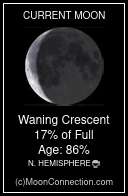
Timing was also an important consideration for the performance of this rite. Night was the chosen time, preferably on or around midnight, or no later than three in the morning, and when the moon was full. The best time of the year to perform this rite would have been in the autumn, for obvious reasons (it is the time of death), and the preferable date in our modern era would be around the end of October, during Samhain or All Saints Day, or the Day of the Dead.
Finally, the most important component of this rite (in my opinion) is the linkage between the seeker and the deceased person that he or she wishes to contact. A suitable and specific target for the rite must be established before it is even attempted. It is better if that target is a blood relative or a departed member of one’s family, but spiritual kinship can also be used as a link to the ghost of the departed. Seekers should have something that helps them to identify and also connect with the deceased, such as old belongings or a prized possession. Still, a single photograph of the deceased can be sufficient to act as the focus of a necromantic rite. A photograph and other items should be treated as if they were aspects of the deceased - in other words, one should address petitions and other exhortations to the picture or belongings as if they were that person. This may require some meditation and even some trance work to assist one in making this crucial mental connection.
One thing we probably should discuss here is whether or not this kind of rite can be performed successfully today. To perform it is to assume that the spirits of dead indefinitely reside in an underworld reality and that they are accessible to certain kinds of magickal or liturgical operations. This assumption might not be part of the seeker’s spiritual beliefs, which would cause some fundamental problems when attempting to perform this rite. If an occultist and pagan believes in reincarnation, then there is the question of what exactly, if anything, is being summoned in a necromantic rite. Some writers in antiquity believed that only the recently dead were accessible using necromantic rites, so that after a month or two, the deceased had completely passed over into the underworld and was no longer available. Others presented ideas and stories that would contradict this rule, so even in antiquity there wasn’t a set of assumptions that could be agreed upon by everyone.
My opinion is that a necromantic rite can’t be seen as a completely objective means of summoning and materializing the ghosts of the departed. It requires the strong association and bond between the seeker and the deceased, so what does manifest is mostly in the mind and soul of the living person and only partially associated with the deceased. What this means is that the degree of success of this rite has a lot to do with the strength of the bond between the living seeker, the deceased ancestor and the psychic atmosphere and environment of the working. If the seeker feels a powerful and haunting bond with the targeted deceased, and there is a great deal of psychic stimulation generated from the performance of the rite, then the outcome will undoubtedly be profound. So whether a necromantic rite truly materializes a departed spirit is subject to debate. The ritual, however, is quite effective, and it does give the seeker an empowered sense of having contacted and communed with the spirit of the dead. I know this because I have performed variations of this rite in the past, and in fact, led a similar rite a few years ago for a Samhain celebration.
Another objection that could be made is that necromancy is nothing more than a ritually conflated form of channeling or performing a seance. One could argue that using elaborate rituals to commune or communicate with the dead is completely unnecessary, since simpler forms of divination or psychic communication are all that is required. However, necromancy has a verifiable historical precedence and an antique pedigree that has continued to make it an item of interest and engagement throughout the centuries. For every occult methodology there are probably a multitude of ways to accomplish the same exact end, so whichever one we choose represents how we believe, function and accomplish our ends within the various occult disciplines. If one is a reputed psychic or master diviner, then that will be the methodology that one would employ to communicate with the dead; yet if one is a ritual magician, then perhaps a ritual working might be used instead.
A necromantic ritual is only one of many methods of doing this kind of work, and perhaps it is the more obscure or even forbidden method, compared to all of the others. Still, a necromantic rite causes the seeker, the guide and attendees to be completely immersed into a kind of temporary mystery temple of death, where they not only commune with the targeted shade of the deceased, but also experience a transformative insight into the nature of life itself. Through a manifestation of this mystery, participants learn first hand what might transpire for anyone after their own death. I suspect that a seance, a channeling or a divination session would not have quite the same dramatic or transformative effect as performing a necromantic working, but then, that is my opinion and I am, after all, a biased ritual magician.
So the reasons for performing a necromantic rite are to commune directly with the dead (in their domain) and to acquire a perspective on death and the nature of the afterlife. Necromancy offers complete immersion within the core of this mystery of death, where other forms may not be so powerful or dramatic. This means that the rite of necromancy can enable a person to directly experience and undergo one of the five integral mysteries, so it can also be understood as a form of initiation. Therefore, a properly done necromantic rite is much more than just an exercise in divination.
Now that we’ve covered these preliminary topics and laid down some basic considerations, let us move on to discuss the structure and components for a modern necromantic rite.
A Necromantic Ritual
As I stated previously, a necromantic rite is a form of a mystery initiation, so therefore it must be performed in a properly erected temple of the mysteries. If such a location is not available, and usually it isn’t, then an alternative domain must be generated in some fashion. The mystery of death is performed in a “telesterion” (mystery temple), whether one performs this rite in an outdoor sacred grove or within an indoor temple. Some specific components or structures should be incorporated so that the ritual is performed within a place where one can directly experience an incursion of the “radical other.”
If the environment where this rite is to be performed is unable to inflame the imagination and give those undergoing the rite a powerful sense of awe and even fear, then the rite will fail to produce the required transformation. An artful combination of decorations, props, fetishes, deliberations and perhaps even some mind altering exercises (or substances) should be performed to enhance the ritual process. Yet more importantly, the attendees should undergo purification, some fasting, contemplation on the target deceased, meditation on their own death, the generation of sacred space, the erection of a vortex, the opening of a western aligned gateway into the underworld and the laying down of a cross-roads. However, let us go over each of these important components and describe them in detail.
Self-Preparations: Spend some time undergoing a regimen of purification, fasting, sequestering, meditation and contemplation. Choose a photo of the targeted deceased and accompany it with any additional items or possessions that one might have. A skull, whether fake or real, should be used as a meditation tool to aid in preparing the mind. Spend some time meditating and contemplating on the deceased as well as one’s own death. Then, when a suitable period of preparation has been completed, those who will be attending the rite will don black robes and place some kind of black wreath around their heads. The leader of this working may even wear makeup to look like a dead person, whitening the face and darkening the lips and the area around the eyes and nose. All participants are anointed with fragrant oils that have a heavy scent, such as lavender, olibanum, or myrrh.
Tools required: A wand, sword or dagger, incense burner and a binding stone are the necessary tools used in this rite. The wand can be made of gold, fashioned to look like a caduceus wand, or it may be a simple stave with a pine cone tip. The wand is used to call and summon the dead. The dagger or sword is used as a warding tool, and it should be consecrated. An incense burner, thurible or brazier, is used to burn the special incense of storax or other suitable herb/resin. A binding stone is a special consecrated stone that the leader can comfortably hold in his or her palm. It is used to control, bind and release the spirit of the ghost.
Temple/Grove: If this rite is being performed in an outdoor grove, then a shallow pit is dug, as well as a fire pit for the fire. A circle can be etched into the ground, but it’s not necessary. The shallow pit will be used to hold the sacrificial offerings that are consigned to the earth. If the outdoor grove is near a body a water, then the liquid sacraments (such as wine) may be offered there. If the rite is performed in an indoor temple, then a pan should be used to collect the offerings so that they can be given to the earth when the rite is over. An indoor temple would also use a large black candle instead of a fire. An altar or central marker can be used, or where the world-pole or stang is placed – this is where the flowers should be placed along with the pictures and belongings of the deceased. (The pictures and belonging will be picked up once the necromantic rite begins.) The area where the seeker(s) will be performing their incubation rite (sleeping) ideally should consist of black sheep skins. The sleeping area should be within the precincts of the temple or grove, but out of the way of any ritual activity.
Associated Godhead: Deities associated with death (in one’s tradition) should be researched and hymns/invocations for them be written or adapted from available lore. Examples of such deities in the Greek tradition would be Hades, Persephone, Hecate, Hermes or Dionysus/Bacchus, or demi-gods such as Orpheus, Heracles or Pythagorus. It is assumed that those who are attending this rite will be associated with the same pagan tradition. The gods of the dead should be known and easily recognized by all.
Offerings: Food and drink that will be used as offerings, such as bread or cakes, fruit, cooked meat, wine, milk, honey, barley and salt-water. The wine and salt-water can be combined as a replacement for fresh blood - so, too, the cooked meat. Substituting blood for sea water or salt water can be done because mammalian lymph and blood plasma possess the same basic mineral composition as sea water (about 1.5 grams of salt per pint). Another kind of substitution is called “omiero”, which is a substance created in the rites of Santeria. It consists of water mixed with certain plant juices, and is used as a substitute for sacrificial blood as a kind of vegetarian offering. (Thus one might even use tomato juice as a blood substitute.) Flowers, such as red roses or white lilies, would be good, as well as other colorful flower arrangements, similar to what is offered at funerals. All of these offerings are to be given to the Godhead and the deceased, none of it is to be consumed or used by the attendees. A separate container or containers of water are the only allowed drink for the attendees.
The chief celebrant and attendees, along with the seeker(s) assemble in a sacred grove or indoor temple. The following nine steps represent the preliminary directions for formulating a mystery rite. They were taken from my third article on modern mystery rites.
1. Establishing Sacred Space - for witches and pagans, this would involve performing a circle consecration rite. One should also perform personal ablutions (magickal bath) and extensive devotional meditations and offerings. The purpose is to prepare the self and the space so that Spirit may become realized and enter into that place.
2. Erecting a spiral vortex - the energy field that most “resembles” the sealed container of a telesterion is a vortex. The vortex has the properties of amplifying and isolated all energies and actions performed within it. This makes the perfect foundation for performing a mystery.
3. Underworld Gateway - a western aligned gateway establishes the internal transition of the isolated chamber of the mysteries, and draws it deeper into the spectral unconscious domain of the underworld.
4. Erect the cross-roads - a four or eight node cross-roads establish a powerful nexus point where all forces and aspects of Spirit may descend or ascend. The four or eight nodes can be qualified to represent the specific nature of the mystery, whether Lunar, Solar or Self.
5. Establish an inner circle - overlaying the cross-roads is an inner circle, representing the place of the interstice where Spirit resides and where one may actively engage with it. The inner circle is drawn and then opened like a gateway portal.
6. Introit of the Mystery - the preliminary rites that are performed just prior to the activation of the mystery rite are as follows:
Erection and veneration of the World Pole (Stang): The celebrant places a special sacral staff or Stang in the center of the circle, acting as a conduit between all worlds. The staff or Stang may be set up to stand by itself, or it may be held by an assistant.
Godhead invocation, assumption and sacral consecration: This is where the celebrant summons the specific godhead associated with the mystery, then performs an assumption rite so the spirit of the godhead and the celebrant are merged. Yet the celebrant is still conscious and able to function (at least at this point in the working). Sacraments associated with the mystery are blessed and charged by the celebrant.
7. Mythic Theme - the mythic theme is presented as a narration, with symbols and fetishes used to emphasize the theme of the mystery. The celebrant may assume a deep trance and act as the oracle of the specific deity. Deep meditation and trance are required by all participants to acquire the most intrinsic level of the mystery. Knuckle bone divination (dice) can be thrown at this point to establish auguries, as well as the consumption of specific mind altering substances and intense and extreme yogic asanas (pranayama: lotus 7-breath). The purpose of this climax of intensity is to obtain a state of ecstasy.
(We will look at the mythic themes for necromancy in the next section.)
8. Inner circle is closed, sealed, then the four or eight nodes of the crossroads are sealed with sealing spirals. Then an eastern gateway is opened and the Celebrant, along with accomplices, ascend out of the chamber of the mysteries and into a new dawn of rebirth and restoration, passing the eastern gateway much like the rising of the sun. (The western gateway points are sealed just before the eastern gateway is established.)
9. An outer feast is assembled, where food and drink are blessed and shared. A portion of this feast is given as an offering to the godhead associated with the mystery. The rite is concluded.
If the mystery working is to be done in a grove instead of an indoor temple, then the basic rules of managing a grove are to be used. That means that steps 1 through 3 are to be handled differently, depending on the grove architecture. The other steps can be modified and developed differently as the attendees see fit. For instance, the cross roads can be etched into the ground or even permanently marked within the grove circle. So, too, the gateways can consist of built up edifices as well as the sacred pathways into the grove telesterion.
Mythic Themes and Actions for Necromancy
Once all of the components for the telesterion are established, and the cross-roads, world-pole and the specific godheads have been invoked with praise, hymns and exhortation, then the necromantic mystery can be properly begun. The chief celebrant begins this mystery by imploring, demanding and begging the Godhead to intercede and aid in the quest to communicate with the targeted deceased spirits.
Immediately following the godhead invocation and assumption, then the chief celebrant will perform the sacrificial offering, both to the dead and the chthonic godhead. If outdoors, the offering is poured and distributed into the pit, if indoors, it is placed in a large pan. A handful of barley is sprinkled over it. A single flower is placed in with the offerings for each ghost that a seeker wishes to communicate. Storax incense is burned (in the fire pit, if done in a grove) and the other attendees walk slowly around the periphery of the circle in a widdershins direction. (They may engage in an appropriate chant or song, too.) The incense should produce large puffs of incense, then be allowed to burn out, to be followed by a few more puffs. If outside, then clouds of incense smoke can be produced.
Then the chief celebrant, who is kneeling in the center of the circle (near the fire/candle and the pit/pan) begins to read the incantation to the dead while holding the wand aloft with the left hand, and touching the skull with the left knee, saying the words in a screeching, shrieking and highly vibratory intonation – it should sound strange, weird and even a bit frightening. When the incantation is begun, the seeker(s) break off the circumambulation to kneel near the chief celebrant, taking with them the picture and items of the deceased, which becomes the sole focus. One of the assistants takes up a sword or dagger and positions himself in the West, warding the open gateway therein, while the others take up positions at the periphery of the circle.
The incantation is read three times; then there is a period of silence as the celebrant seeks to hear and connect with the dead. The celebrant puts down the wand and takes up the binding stone in the left hand. Then the celebrant intones the name of the targeted deceased while gripping the stone, with the name being recited slowly three times, followed by silence, then repeated again. After the first time, the seeker adds his/her voice to the calling. This cycle of calling and silence goes on until the seeker senses that the shade of the deceased has appeared, and signals with the left hand to stop.
This process is repeated for each of the targeted deceased, until all have been called. Then there is silence while everyone meditates in a seated position at the place where they had been standing or kneeling. The seeker(s) continue to focus all of their attention on the photo and items of the deceased, and then open themselves up to allowing the spirit of the dead to fully connect with them, perhaps even silently talking to the pictures and belongings. This may also require a deep trance state, so they will have already performed the steps to assume this state, making it as deep and intense as possible.
Then, once this final period of spirit binding has reached a successful conclusion, the seeker(s) will retire to the sheep skins to meditate and after a while, to sleep. Any dreams, visions or insights will be noted later in their journals.
Celebrant and assistants will watch over the sleeping seeker(s) until they reawaken or until the first light of dawn, when the mystery rite is concluded as written above. The binding stone will be held in the celebrant’s palm until the work is completed, then the stone is released and allowed to drop, signifying that the binding process is over and the spirits are released. To aid the banishing of spirits, the celebrant may flick some drops of milk around the western gate, if the rite is held in a grove.
There is no communal meal in the telesterion of the dead, but after the rite is completed, there is a joyous feast to celebrate the successful outcome of the rite, to rejoice for the living and to honor the dead. A portion of the food is gathered together for a final offering. Offerings that can be burnt (such as meat) are put into a fire, those that are liquid are released into a lake or stream (if there is one), and the rest is buried in the earth.
A final word about the incantation. No one alive today actually knows how the incantation (goos) of the goetes or necromantic sorcerers sounded. However, we can make use of certain incantations that specifically reference the power of raising the dead in a necromantic context. These incantations are found in the PGM, and for those who are interested in distilling them for this working, I will cite them here. I would recommend that the celebrant practice these incantations, and work to make them sound as unearthly and strange as possible. They should sound like a lamentation for the dead, a keening and screeching kind of crying out. If intoning these words in this manner causes one to actually shed tears, then that might be considered the optimal expression.
Recommended PGM sections:
PGM XVIIb
PGM IV (1928 - 2125)
PGM XVI (1 - 75)
(I am certain that there are other incantations in the PGM that would applicable as well.)
Using the above ritual pattern and recommendations, I believe that the average ritual magician should be able to produce a very workable and profound necromantic mystery rite. I look forward to hearing from anyone who uses these recommendations and other input to produce a proper working, and then report back to me the results. If the results are interesting and compelling, and I get the proper permissions, I promise to produce portions of it here for everyone to read.
I have written an article previously about necromancy as it was practiced in antiquity, and I wanted to follow this up with an article outlining how one would perform a rite of necromancy in modern times, following a basic neopagan perspective. You can find the previous article here. Also, most of these steps and components were taken from the book “Greek and Roman Necromancy” by Daniel Ogden (Princeton University Press 2001), in chapter 11 – I highly recommend this book.
First of all, let’s define exactly what I mean by necromancy, since there are a lot of different opinions about this rather controversial type of magick. My approach is to engage with the dead, most notably honorable ancestors or honorable spiritual, magickal or occult mentors, seeking communion with such spirits for the purpose of inspiration and guidance. I believe that such an engagement should be performed with respect, veneration and dignity for the targeted deceased.
What I am not advocating is digging up a grave and reanimating a corpse or using extracted body parts from the same for some kind of coercive rite that violates the sanctity of the dead. So the operation that I am proposing is a form of communal divination, which uses trance and incubation to achieve its end. I believe that this is more in line with how necromancy was performed in antiquity, despite the lurid tales of witches, Persian magi and evil Egyptian sorcerers from that time, or some of the more darker forms of magick as found in the Greek Magical Papyri (PGM).
Sacrifice was the core action associated with necromancy in antiquity (although some will debate this issue), specifically the sacrifice of one or two black sheep, whose heads were turned down towards the underworld when killed. The blood was collected into a pit so it could be used to materialize the shades of the ghosts and also act as a proper gift to the chthonic gods of the underworld (their corpses were flayed and all of the meat was burned). Location was also important, since the practitioner and his or her assistants needed to have access to the underworld in order to acquire a proper link to the ghosts of the departed. Both of these requirements, as established by practices in antiquity, could be replaced with other more modern or suitable substitutions without adversely affecting the potency of the rite. We will speak more about sacrifice and its substitutions later in this article.
Timing was also an important consideration for the performance of this rite. Night was the chosen time, preferably on or around midnight, or no later than three in the morning, and when the moon was full. The best time of the year to perform this rite would have been in the autumn, for obvious reasons (it is the time of death), and the preferable date in our modern era would be around the end of October, during Samhain or All Saints Day, or the Day of the Dead.
Finally, the most important component of this rite (in my opinion) is the linkage between the seeker and the deceased person that he or she wishes to contact. A suitable and specific target for the rite must be established before it is even attempted. It is better if that target is a blood relative or a departed member of one’s family, but spiritual kinship can also be used as a link to the ghost of the departed. Seekers should have something that helps them to identify and also connect with the deceased, such as old belongings or a prized possession. Still, a single photograph of the deceased can be sufficient to act as the focus of a necromantic rite. A photograph and other items should be treated as if they were aspects of the deceased - in other words, one should address petitions and other exhortations to the picture or belongings as if they were that person. This may require some meditation and even some trance work to assist one in making this crucial mental connection.
One thing we probably should discuss here is whether or not this kind of rite can be performed successfully today. To perform it is to assume that the spirits of dead indefinitely reside in an underworld reality and that they are accessible to certain kinds of magickal or liturgical operations. This assumption might not be part of the seeker’s spiritual beliefs, which would cause some fundamental problems when attempting to perform this rite. If an occultist and pagan believes in reincarnation, then there is the question of what exactly, if anything, is being summoned in a necromantic rite. Some writers in antiquity believed that only the recently dead were accessible using necromantic rites, so that after a month or two, the deceased had completely passed over into the underworld and was no longer available. Others presented ideas and stories that would contradict this rule, so even in antiquity there wasn’t a set of assumptions that could be agreed upon by everyone.
My opinion is that a necromantic rite can’t be seen as a completely objective means of summoning and materializing the ghosts of the departed. It requires the strong association and bond between the seeker and the deceased, so what does manifest is mostly in the mind and soul of the living person and only partially associated with the deceased. What this means is that the degree of success of this rite has a lot to do with the strength of the bond between the living seeker, the deceased ancestor and the psychic atmosphere and environment of the working. If the seeker feels a powerful and haunting bond with the targeted deceased, and there is a great deal of psychic stimulation generated from the performance of the rite, then the outcome will undoubtedly be profound. So whether a necromantic rite truly materializes a departed spirit is subject to debate. The ritual, however, is quite effective, and it does give the seeker an empowered sense of having contacted and communed with the spirit of the dead. I know this because I have performed variations of this rite in the past, and in fact, led a similar rite a few years ago for a Samhain celebration.
Another objection that could be made is that necromancy is nothing more than a ritually conflated form of channeling or performing a seance. One could argue that using elaborate rituals to commune or communicate with the dead is completely unnecessary, since simpler forms of divination or psychic communication are all that is required. However, necromancy has a verifiable historical precedence and an antique pedigree that has continued to make it an item of interest and engagement throughout the centuries. For every occult methodology there are probably a multitude of ways to accomplish the same exact end, so whichever one we choose represents how we believe, function and accomplish our ends within the various occult disciplines. If one is a reputed psychic or master diviner, then that will be the methodology that one would employ to communicate with the dead; yet if one is a ritual magician, then perhaps a ritual working might be used instead.
A necromantic ritual is only one of many methods of doing this kind of work, and perhaps it is the more obscure or even forbidden method, compared to all of the others. Still, a necromantic rite causes the seeker, the guide and attendees to be completely immersed into a kind of temporary mystery temple of death, where they not only commune with the targeted shade of the deceased, but also experience a transformative insight into the nature of life itself. Through a manifestation of this mystery, participants learn first hand what might transpire for anyone after their own death. I suspect that a seance, a channeling or a divination session would not have quite the same dramatic or transformative effect as performing a necromantic working, but then, that is my opinion and I am, after all, a biased ritual magician.
So the reasons for performing a necromantic rite are to commune directly with the dead (in their domain) and to acquire a perspective on death and the nature of the afterlife. Necromancy offers complete immersion within the core of this mystery of death, where other forms may not be so powerful or dramatic. This means that the rite of necromancy can enable a person to directly experience and undergo one of the five integral mysteries, so it can also be understood as a form of initiation. Therefore, a properly done necromantic rite is much more than just an exercise in divination.
Now that we’ve covered these preliminary topics and laid down some basic considerations, let us move on to discuss the structure and components for a modern necromantic rite.
A Necromantic Ritual
As I stated previously, a necromantic rite is a form of a mystery initiation, so therefore it must be performed in a properly erected temple of the mysteries. If such a location is not available, and usually it isn’t, then an alternative domain must be generated in some fashion. The mystery of death is performed in a “telesterion” (mystery temple), whether one performs this rite in an outdoor sacred grove or within an indoor temple. Some specific components or structures should be incorporated so that the ritual is performed within a place where one can directly experience an incursion of the “radical other.”
If the environment where this rite is to be performed is unable to inflame the imagination and give those undergoing the rite a powerful sense of awe and even fear, then the rite will fail to produce the required transformation. An artful combination of decorations, props, fetishes, deliberations and perhaps even some mind altering exercises (or substances) should be performed to enhance the ritual process. Yet more importantly, the attendees should undergo purification, some fasting, contemplation on the target deceased, meditation on their own death, the generation of sacred space, the erection of a vortex, the opening of a western aligned gateway into the underworld and the laying down of a cross-roads. However, let us go over each of these important components and describe them in detail.
Self-Preparations: Spend some time undergoing a regimen of purification, fasting, sequestering, meditation and contemplation. Choose a photo of the targeted deceased and accompany it with any additional items or possessions that one might have. A skull, whether fake or real, should be used as a meditation tool to aid in preparing the mind. Spend some time meditating and contemplating on the deceased as well as one’s own death. Then, when a suitable period of preparation has been completed, those who will be attending the rite will don black robes and place some kind of black wreath around their heads. The leader of this working may even wear makeup to look like a dead person, whitening the face and darkening the lips and the area around the eyes and nose. All participants are anointed with fragrant oils that have a heavy scent, such as lavender, olibanum, or myrrh.
Tools required: A wand, sword or dagger, incense burner and a binding stone are the necessary tools used in this rite. The wand can be made of gold, fashioned to look like a caduceus wand, or it may be a simple stave with a pine cone tip. The wand is used to call and summon the dead. The dagger or sword is used as a warding tool, and it should be consecrated. An incense burner, thurible or brazier, is used to burn the special incense of storax or other suitable herb/resin. A binding stone is a special consecrated stone that the leader can comfortably hold in his or her palm. It is used to control, bind and release the spirit of the ghost.
Temple/Grove: If this rite is being performed in an outdoor grove, then a shallow pit is dug, as well as a fire pit for the fire. A circle can be etched into the ground, but it’s not necessary. The shallow pit will be used to hold the sacrificial offerings that are consigned to the earth. If the outdoor grove is near a body a water, then the liquid sacraments (such as wine) may be offered there. If the rite is performed in an indoor temple, then a pan should be used to collect the offerings so that they can be given to the earth when the rite is over. An indoor temple would also use a large black candle instead of a fire. An altar or central marker can be used, or where the world-pole or stang is placed – this is where the flowers should be placed along with the pictures and belongings of the deceased. (The pictures and belonging will be picked up once the necromantic rite begins.) The area where the seeker(s) will be performing their incubation rite (sleeping) ideally should consist of black sheep skins. The sleeping area should be within the precincts of the temple or grove, but out of the way of any ritual activity.
Associated Godhead: Deities associated with death (in one’s tradition) should be researched and hymns/invocations for them be written or adapted from available lore. Examples of such deities in the Greek tradition would be Hades, Persephone, Hecate, Hermes or Dionysus/Bacchus, or demi-gods such as Orpheus, Heracles or Pythagorus. It is assumed that those who are attending this rite will be associated with the same pagan tradition. The gods of the dead should be known and easily recognized by all.
Offerings: Food and drink that will be used as offerings, such as bread or cakes, fruit, cooked meat, wine, milk, honey, barley and salt-water. The wine and salt-water can be combined as a replacement for fresh blood - so, too, the cooked meat. Substituting blood for sea water or salt water can be done because mammalian lymph and blood plasma possess the same basic mineral composition as sea water (about 1.5 grams of salt per pint). Another kind of substitution is called “omiero”, which is a substance created in the rites of Santeria. It consists of water mixed with certain plant juices, and is used as a substitute for sacrificial blood as a kind of vegetarian offering. (Thus one might even use tomato juice as a blood substitute.) Flowers, such as red roses or white lilies, would be good, as well as other colorful flower arrangements, similar to what is offered at funerals. All of these offerings are to be given to the Godhead and the deceased, none of it is to be consumed or used by the attendees. A separate container or containers of water are the only allowed drink for the attendees.
The chief celebrant and attendees, along with the seeker(s) assemble in a sacred grove or indoor temple. The following nine steps represent the preliminary directions for formulating a mystery rite. They were taken from my third article on modern mystery rites.
1. Establishing Sacred Space - for witches and pagans, this would involve performing a circle consecration rite. One should also perform personal ablutions (magickal bath) and extensive devotional meditations and offerings. The purpose is to prepare the self and the space so that Spirit may become realized and enter into that place.
2. Erecting a spiral vortex - the energy field that most “resembles” the sealed container of a telesterion is a vortex. The vortex has the properties of amplifying and isolated all energies and actions performed within it. This makes the perfect foundation for performing a mystery.
3. Underworld Gateway - a western aligned gateway establishes the internal transition of the isolated chamber of the mysteries, and draws it deeper into the spectral unconscious domain of the underworld.
4. Erect the cross-roads - a four or eight node cross-roads establish a powerful nexus point where all forces and aspects of Spirit may descend or ascend. The four or eight nodes can be qualified to represent the specific nature of the mystery, whether Lunar, Solar or Self.
5. Establish an inner circle - overlaying the cross-roads is an inner circle, representing the place of the interstice where Spirit resides and where one may actively engage with it. The inner circle is drawn and then opened like a gateway portal.
6. Introit of the Mystery - the preliminary rites that are performed just prior to the activation of the mystery rite are as follows:
Erection and veneration of the World Pole (Stang): The celebrant places a special sacral staff or Stang in the center of the circle, acting as a conduit between all worlds. The staff or Stang may be set up to stand by itself, or it may be held by an assistant.
Godhead invocation, assumption and sacral consecration: This is where the celebrant summons the specific godhead associated with the mystery, then performs an assumption rite so the spirit of the godhead and the celebrant are merged. Yet the celebrant is still conscious and able to function (at least at this point in the working). Sacraments associated with the mystery are blessed and charged by the celebrant.
7. Mythic Theme - the mythic theme is presented as a narration, with symbols and fetishes used to emphasize the theme of the mystery. The celebrant may assume a deep trance and act as the oracle of the specific deity. Deep meditation and trance are required by all participants to acquire the most intrinsic level of the mystery. Knuckle bone divination (dice) can be thrown at this point to establish auguries, as well as the consumption of specific mind altering substances and intense and extreme yogic asanas (pranayama: lotus 7-breath). The purpose of this climax of intensity is to obtain a state of ecstasy.
(We will look at the mythic themes for necromancy in the next section.)
8. Inner circle is closed, sealed, then the four or eight nodes of the crossroads are sealed with sealing spirals. Then an eastern gateway is opened and the Celebrant, along with accomplices, ascend out of the chamber of the mysteries and into a new dawn of rebirth and restoration, passing the eastern gateway much like the rising of the sun. (The western gateway points are sealed just before the eastern gateway is established.)
9. An outer feast is assembled, where food and drink are blessed and shared. A portion of this feast is given as an offering to the godhead associated with the mystery. The rite is concluded.
If the mystery working is to be done in a grove instead of an indoor temple, then the basic rules of managing a grove are to be used. That means that steps 1 through 3 are to be handled differently, depending on the grove architecture. The other steps can be modified and developed differently as the attendees see fit. For instance, the cross roads can be etched into the ground or even permanently marked within the grove circle. So, too, the gateways can consist of built up edifices as well as the sacred pathways into the grove telesterion.
Mythic Themes and Actions for Necromancy
Once all of the components for the telesterion are established, and the cross-roads, world-pole and the specific godheads have been invoked with praise, hymns and exhortation, then the necromantic mystery can be properly begun. The chief celebrant begins this mystery by imploring, demanding and begging the Godhead to intercede and aid in the quest to communicate with the targeted deceased spirits.
Immediately following the godhead invocation and assumption, then the chief celebrant will perform the sacrificial offering, both to the dead and the chthonic godhead. If outdoors, the offering is poured and distributed into the pit, if indoors, it is placed in a large pan. A handful of barley is sprinkled over it. A single flower is placed in with the offerings for each ghost that a seeker wishes to communicate. Storax incense is burned (in the fire pit, if done in a grove) and the other attendees walk slowly around the periphery of the circle in a widdershins direction. (They may engage in an appropriate chant or song, too.) The incense should produce large puffs of incense, then be allowed to burn out, to be followed by a few more puffs. If outside, then clouds of incense smoke can be produced.
Then the chief celebrant, who is kneeling in the center of the circle (near the fire/candle and the pit/pan) begins to read the incantation to the dead while holding the wand aloft with the left hand, and touching the skull with the left knee, saying the words in a screeching, shrieking and highly vibratory intonation – it should sound strange, weird and even a bit frightening. When the incantation is begun, the seeker(s) break off the circumambulation to kneel near the chief celebrant, taking with them the picture and items of the deceased, which becomes the sole focus. One of the assistants takes up a sword or dagger and positions himself in the West, warding the open gateway therein, while the others take up positions at the periphery of the circle.
The incantation is read three times; then there is a period of silence as the celebrant seeks to hear and connect with the dead. The celebrant puts down the wand and takes up the binding stone in the left hand. Then the celebrant intones the name of the targeted deceased while gripping the stone, with the name being recited slowly three times, followed by silence, then repeated again. After the first time, the seeker adds his/her voice to the calling. This cycle of calling and silence goes on until the seeker senses that the shade of the deceased has appeared, and signals with the left hand to stop.
This process is repeated for each of the targeted deceased, until all have been called. Then there is silence while everyone meditates in a seated position at the place where they had been standing or kneeling. The seeker(s) continue to focus all of their attention on the photo and items of the deceased, and then open themselves up to allowing the spirit of the dead to fully connect with them, perhaps even silently talking to the pictures and belongings. This may also require a deep trance state, so they will have already performed the steps to assume this state, making it as deep and intense as possible.
Then, once this final period of spirit binding has reached a successful conclusion, the seeker(s) will retire to the sheep skins to meditate and after a while, to sleep. Any dreams, visions or insights will be noted later in their journals.
Celebrant and assistants will watch over the sleeping seeker(s) until they reawaken or until the first light of dawn, when the mystery rite is concluded as written above. The binding stone will be held in the celebrant’s palm until the work is completed, then the stone is released and allowed to drop, signifying that the binding process is over and the spirits are released. To aid the banishing of spirits, the celebrant may flick some drops of milk around the western gate, if the rite is held in a grove.
There is no communal meal in the telesterion of the dead, but after the rite is completed, there is a joyous feast to celebrate the successful outcome of the rite, to rejoice for the living and to honor the dead. A portion of the food is gathered together for a final offering. Offerings that can be burnt (such as meat) are put into a fire, those that are liquid are released into a lake or stream (if there is one), and the rest is buried in the earth.
A final word about the incantation. No one alive today actually knows how the incantation (goos) of the goetes or necromantic sorcerers sounded. However, we can make use of certain incantations that specifically reference the power of raising the dead in a necromantic context. These incantations are found in the PGM, and for those who are interested in distilling them for this working, I will cite them here. I would recommend that the celebrant practice these incantations, and work to make them sound as unearthly and strange as possible. They should sound like a lamentation for the dead, a keening and screeching kind of crying out. If intoning these words in this manner causes one to actually shed tears, then that might be considered the optimal expression.
Recommended PGM sections:
PGM XVIIb
PGM IV (1928 - 2125)
PGM XVI (1 - 75)
(I am certain that there are other incantations in the PGM that would applicable as well.)
Using the above ritual pattern and recommendations, I believe that the average ritual magician should be able to produce a very workable and profound necromantic mystery rite. I look forward to hearing from anyone who uses these recommendations and other input to produce a proper working, and then report back to me the results. If the results are interesting and compelling, and I get the proper permissions, I promise to produce portions of it here for everyone to read.
Frater Barrabbas

