Showing posts with label energy theory of magic. Show all posts

Saturday, December 9, 2023

Why the Energy Model of Magic is Important


Since the grimoire-only crowd and their ritual tech has become quite popular, they have espoused a spirit-only model of magic. That approach has given short shrift to a perfectly acceptable, and I might add, useful model of magic, which is a major part of a number of different, albeit, modern systems of magic. While it is true that the learned and literate of the previous age believed that humanity lacked any kind of personal power to effect the world around them, we now know that this is no longer the case. Human beings have a greater potential to effect the world around them, and they also have an innate magical power or energy to be able to do so. These ideas about human energy have come from Eastern metaphysical traditions, but there is evidence that the philosophers of antiquity believed in the potential for humans to generate and project power or energy if suitably trained.

You might consider that whether one follows the spirit-only model or the energy model, the psychology model, or the stochastic chaos model, or the information model that it doesn’t really make much difference in the magic that is deployed. Additionally, most modern systems of magic employ more than one model simultaneously than only electing to use one model in isolation. Yet the question remains about why the energy model of magic is so important in the kinds of ritual tech that I employ? What do these techniques give to the magic that I perform?

First of all, the energy model of magic is tied to the breath and movement of the operator. The regulation of breath appears to alter the states of consciousness that one assumes, and movement brings to the ritual bodily projected energy, both thermal and bio-electric. These physical energy types are very minute, although the thermal energy of a crowd of people can be significant in an enclosed space. However, it is the altered state of consciousness combined with physical movement that makes magical energies perceptible to the magical operator. Add to that mixture of altered conscious mental state and bodily exertions the various occult symbology and tight ritual structures and you will get a potent output of energy that is tangible and perceptible. By itself, the energy model can promote an empowered will-base magical working that can and does have some limited success in bending the probabilities for an expected outcome. Combined with other models of magic and this methodology becomes a very potent and successful tool in adding magical power to working and making spirit workings assume a more tangible manifestation.

For instance, my ritual tech for projecting an elemental power toward a given objective uses the energy model to create a pentagram-based octagonal elemental vortex, along with invoking an elemental based spirit, sealed with a sigil symbolizing my objective. That combination of energy, spirit and information models of magic, with an implied psychology model (developing specific mind-states along with the spiritual intelligence of the Elemental Spirit) produces a ritual tech that can bend probabilities much readily than the energy model alone.

I also perform my workings under a godhead assumption and in alignment to my personal deity, thereby making the working into a form of theurgy. The octagon structure gives a structure to the generated energies, and the inward and outward spirals compress and release the imprinted energy field that is imprinted by the sigil and guided by the Elemental Spirit. This represents succinctly and all-model approach to performing a simple magical effect on an outward material condition. The more elaborate ritual tech that I employ uses even more complex ritual structures and layers them within the same working area of the eight-node magic circle. The greater energy concentration will produce materializations, especially if more exalted spirits are involved, such as Angels or Demons. In fact, combining these models into a single working makes it more effective and the objectives, whether material or spiritual,  more likely to be achieved.

As you can see, a multi-model magical approach that uses an advanced energy model of magic is much more effective and produces a greater range phenomena than if a magician were to adhere to just one single model, such as the spirit-only model used in traditional grimoire magic. I think that this single model approach to magic is very limited and far less effective. For the spirit-only model it relies on a mind-set and belief system that is more relevant to the 16th century than our post-modern times. This is particularly true for European and American systems of magic and the underlying modern metaphysics that is used in its foundation. The energy, psychological and informational models of magic are more modern by far, but they also have a historical provenance that spans other cultures and times.

What I have found is using the advanced energy model of magic in all of my ritual workings and ordeal makes these processes more intense, tangible and objective to co-workers. They manifest energies that can be felt and experienced even by those who have little experience with magic. A vortex used in a temple space, even when sealed, will continue to resonate on some level and be felt by others who might enter the temple where such magic has been performed. It gives greater emphasis to all magical operations and makes visual apprehension of the magic possible. I have trained myself to see the lines of force when they are drawn, including magical devices, gateways, pylons, vortices and energy compression spirals and energy exteriorization spirals. This allows me to perceive and experience the magical phenomena as it is being generated. I cannot conceive of a better way to gauge a magical operation than to have this ability to sense and perceive it, and the advanced energy model makes this all possible.

Want to know more about the advanced energy model in magic and how to employ it in your own magical workings? My book “Elemental Powers for Witches” is an excellent book that explains the energy model, its historical precedence, but more importantly, how to work this kind of magic and produce tangible results. It even discusses how to learn to see and sense this kind of magical power, and how it can be integrated into an evocation to make the spirit more perceptible and objective. I cannot recommend this book more emphatically then to state that the advanced energy ritual tech is what I have used in all of my advanced ritual workings. If you want to make such future books of mine such as “Liber Nephilim” and “Abramelin Lunar Ordeal” (available in 2024) accessible, then the book “Elemental Powers for Witches” is a critically important source to read and study.

Frater Barrabbas

Saturday, November 12, 2022

Frater Barrabbas Author Literary Tour - Part 6 - Elemental Powers For Witches


My first book in the “For Witches” series was in print by 2017, but by then I had taken on a new job that readily took away all of the my free time. I stopped writing articles in my blog and I was traveling between Minneapolis and Richmond, staying there for three weeks and then going home for a long weekend. I was putting in 60 to 70 hours a week of work, and travel added to that time spent solely on work. I visited my wife and pet kitties for just 48 hours before having to travel back to work in Richmond. Needless to say, that whole project turned out badly for me on one hand, but having to leave it was a reward on the other.

I moved to Richmond to work on that project; but not only did I not get a dime from the company for making that move, I was also pulled off that project because those who had planned the time-line compressed what was two years of work into just eight months. I was punished for missing that time-line, even though it was completely unreasonable. Someone had to be blamed for the project going awry, so as the data manager, I was the one. Certainly, those who proposed such a truncated project time-line to the client couldn’t possibly be blamed for their mistakes, because they were upper management and immune to such accountability. Anyway, I was put on my old project and then had to prove myself for over a year later that I was worthy of keeping that job. It was a time of work and left me with little time for writing and even working magic. Getting booted off of that project was a blessing in disguise, and I went on to getting chosen for a new project where my skills and abilities were at least appreciated.

My work on the next book in this series didn’t start until the Covid-19 Pandemic began to manifest, but I had the concept and even a preliminary table of contents defined before the winter solstice of 2019. So, during the lock-down, I focused on writing my 6th book, and of course it took a lot less time than any of my previous writing endeavors.

This is how the book “Elemental Powers for Witches” was written and published, while the world labored with the first in a hundred years world pandemic. Tragically, many people died from that disease; but I had already begun something of a personal sequestering, so I just continued it and made certain that I had the preventive vaccinations when they became available. I was old, sedentary and suffered from allergies, so I figured that if I got Covid that it would likely greatly harm me, so I took all of the precautions, and luckily, I had been working from home since early 2019.

Here is the  advertising text for that book.

Energy magic uses the power of Elementals, Qualified Elementals and Uncrossing mechanisms to fully empower practitioners and make them materially successful. This book seeks to bring that knowledge to the Modern Witch, making it accessible and easily added to the lore she is already using.

Since the 5th Century BCE, a system of mysticism, religious philosophy and magic was delivered to the world by the philosopher Empedocles, who brought us the knowledge and wisdom of the four Elements of Fire, Air, Water and Earth, and the Aether as Spirit.

Across the ages that knowledge was developed to become the energy model of magic that is used today to fuel material-based rituals. Until now, this methodology was exclusive to ceremonial magicians. This book seeks to take that advanced energy work and place it into the hands of the Modern Witch. These rituals were derived and formulated to be easily accessible to the modern practitioner and to fit what is already a part of their lore.

Energy magic is used to empower individuals so that they can at least feel that they have a chance of dealing with difficulties and adversity. It also gives them methods to address specific deficiencies or to counter adverse circumstances with positive ones. Energy magic is used to build up the self and turn potentials into realized goals. It focuses on the material world because it is the basis for all that occurs in our life and colors our experiences. Because the world is not fair, we need something to help us turn the world slightly to our advantage.

What energy magic is used for is to solve problems within yourself and the circumstances of your life in the material world. It is not only a body of magical rituals and techniques; it is also the way to approach a problem in order to resolve it. There are several steps that are followed when approaching a solution to a given desire or need, and these can be used to also sort out and pin-point the one thing that will open up your possibilities and resolve whatever issue you are facing.

This book was written for Witches, Wiccans, and Pagans who wish to enhance and formalize their approach to the energy workings for self-empowerment and material based magical workings. This book assumes some degree of knowledge in basic practices so it isn’t exactly for beginners, but it does make this type of magic, and the use of the energy and information models of magic, accessible and easily realized. It is also a sequel and companion book to the published work “Spirit Conjuring for Witches” so, certainly the readers who liked that book would likely also enjoy the sequel.
 

As I have pointed out previously, there are three gaps in the magical practices of modern traditional Witchcraft, and these are spirit conjuring, advanced energy workings and talismanic magic. I had just written a book that comprehensively dealt with spirit conjuring from a traditional Witchcraft perspective, so I urged myself to write a book to fill the second gap.

Advanced energy workings represent the basic foundation of magical practices where I significantly extended the repertoire given to me in my initiatory tradition. I did that back in the 1970's not long after being initiated into Witchcraft. I had been working on the cone of power variations for a few years after being introduced to the concept when a version of the Gardnerian Book of Shadows was published by Lady Sheba, and when I had acquired the book “Mastering Witchcraft” by Paul Huson. I also had a copy of “King of the Witches”, which introduced me to Alex Sanders. With these books in hand I was able to put together my own system of Witchcraft based magic. By the time I was initiated on Candlemas Eve, 1973, I already had a system of magic, and I was starting to develop new rituals working with the energy model of magic.

Using an inverse perspective, I deduced that the opposite energy to the obvious masculine cone of power, and that was the feminine vortex. A vortex has a widdershins circuit, and instead of being polarized on the periphery like the cone of power, it uses a cross-roads to join the polarities into the center. The widdershins spiral around the circle performed by the operator is used to concentrate the energy and then push it down into a singularity, making a kind of stable magical black-hole. The vortex was the first variation of the cone of power that I had invented, and it was to be followed by other structures and rituals. Experiencing a vortex generated in a magical circle was a total game-changing stroke of genius, but actually, it was just an obvious step that no one had thought about so far.

While energy workings in traditional Witchcraft magic were a basic staple for the modern practitioner, it was based on a concept that was alien to medieval witchcraft and to ceremonial magic in general. The basic belief about magic was that it was the medium used by and propagated by spirits. Humans were basically powerless, although that was contrary to what the philosophers taught in antiquity. Yet their practices had been mostly lost and what remained was subsumed by the monastic orders of the Catholic Church. Where this idea about human energy came from was the East, and it became part of our western cultural heritage when the teachings of the Indian Yogis became available to the west, around the late 19th to early 20th century.

Studying Yoga became an important part of mastering the art of ceremonial and ritual magic, and many of the early practitioners of the 20th century sought out that knowledge of the East. With Hatha Yoga came prana-yama, yantra, trantra and Kundalini Yoga, and the concept of bodily energy fields that could be harnessed and projected through the breath (prana) became available to the West. It completely changed the way that magicians saw their magic, as evidenced in the writings of Crowley, Bardon, and many others.

Modern Witchcraft was a recipient in that chain of knowledge and it was used in the concepts of energy raising and projecting magical powers. Gardner pretended that this had always been a part of witchcraft from antiquity, except that there was no evidence of this claim and the witches of antiquity typically worked their art in solitary exclusion. It was only in the fever dreams of a handful of scholars who spread the myth of witches meeting in large groups to celebrate their sabbats and worship the devil in the mid 15th century. Gardner’s story about witches gathering together to work magic to prevent Hitler from invading England during the second world war, where even a few older members expired in the frenzied process, was very likely an urban myth.

All evidence seems to support the idea that most witches had practiced their art either completely alone or within small and discrete family traditions. Yet the witchcraft inquisition imagined large groups of witches flying on their brooms and drugged and hallucinating on their toxic ointments, so to them and much of the culture there were indeed large hidden covens working their evil deeds. Gardner took that fantasy and made it into a cultural phenomenon, and the eastern ideas of bodies raising and projecting yogic energy was quietly integrated into that body of practice. By the time that I and others in the early 1970's had joined the Witchcraft tradition, the idea of raising and projecting energy had been a standard part of the practice since Doreen Valiente had reformed it in the 1950's.

However, as a practice, the energy model of magic in modern Witchcraft was simplistic and undeveloped. There was the cone of power and that was about it. I was very much intrigued by the whole concept and set to work to expand and develop how this magical model was used in Witchcraft magic. This is how I came to develop the vortex, then the magical pylon, and then by extension, the pyramid of power, which is a much more sophisticated and nuanced version of the cone of power. Once I started on this path, I continued to work and develop more sophisticated rituals that made use of complex combinations of ritual structures to push the energy model of magic far beyond what I was given as a newly initiated Witch.

The first step that I took was to qualify the undistinguished magical energy into specific qualities. The four elements seemed to be the qualities that I was looking for when it came to describing the magical energies that I sought to use. This pairing of magical energy with the four elements has a long history, and that the elements and the breathing cycle seemed to also be linked. This of course was the Indian concept of prana being merged with the western occult perspective of the four elements. Other practitioners had also made this connection, so that the four elements could be visualized as qualities associated with a certain kind of energy, color and quality and absorbed and projected out through the breath. The four elements could also be qualified with each other to produce sixteen combinations, which I called elementals. Each of these combined elementals also consisted of four pure emanations where an element was combined with itself. At the earliest time in my magical workings I worked with these qualities, but it required a more advanced set of ritual structures to generate them within the magic circle.

To generate an element one can use the invoking pentagram in an efficient manner, which was made public to many practicing magicians through the Golden Dawn writings published by Israel Regardie. Thus, there was the superior pentagram ritual, which I sought to emulate in a fashion. However, to invoke an elemental energy required a more complex ritual structure. The elemental octagon was the key to generating an elemental energy within a magic circle, and liking the shape and quality of that star polygon, I sought to deploy as my ritual pattern for energy workings. I used the four watchtowers and the four angles or in-between points to define the base (watchtowers) and qualifier (angles) of the elemental. To each of these eight points I set the invoking pentagram of the base element (watchtowers) and the invoking pentagram of the qualifying element (angles).

In the center of the circle I set the invoking pentagram to the nadir or infra-point for the base, and to the zenith or ultra-point, I set the invoking pentagram of the qualifier. I also joined the four watchtowers together to form a square, and the four angles to form another square, and then joined the watchtowers to the infra-point and the angles to the ultra-point. Then I stood in the center of the circle with my staff and drew the two elements together through my body and the staff. All that was required to project the elemental energy out into the world was to circumambulate the magic circle with spiral arc, starting in the center of the circle and arcing out to the periphery of the circle, circling three times past the northern watchtower and then projecting the energy with the staff outside of the northern watchtower, thereby exteriorizing it.

I also used a form of sigil magic to symbolize my objective or desire, and I used this to imprint the energy field when it was fully generated. I could have just imprinted it with my mind, but I found that a sigil was more effective. I started out just making a designed but automatic scribble on a piece of parchment while projecting my intention into it. I later adopted a more formal methodology for designing sigils when I was exposed to writings and artwork of that famed magician and pagan witch, Austin Spare. This was how I developed a ritual system to work with elemental energies, but I was not yet completed with this development process.

One approach that I developed was to make use of specific named elemental spirits and integrate them into my magical energy rituals. I used them as intelligent energy fields of empowerment and focused, projected beams of force to influence or even bend the laws of causality. I also incorporated this approach in my magic, making use of the 16 Enochian god-head pairs as derived from the four watchtower tablets and the Enochian calls. I then later matched up the sixteen elemental qualities with the 16 Grand Dukes from the grimoire Theurgia-Goetia and found that they were even more potent than the Enochian elemental spirits. The pairing of a spirit with an elemental quality produced a more powerful combination and helped to animate the elemental magical energy so that it had both power and sentience.

Another approach that I developed, and this was unique to my workings, was to pair an element with one of the ten sephiroth of the Qabalah to generate what I called the 40 qualified powers. Later on, I refined this working by using the Pythagorean definitions of the numbers 1 through 9 and 10, which I felt was more appropriate for a Witchcraft magical approach. When I used the Qabalah, I also qualified the four elements with the four Qabalistic worlds, making a very potent magical combination that existed fully within a Qabalistic domain. If you weren’t into the Qabalah, though, this methodology wouldn’t be as appealing. For this reason I adopted another more simplistic methodology that removed the Qabalistic qualifiers and just used the four elements and the ten Pythagorean mystical numbers. The forty qualified powers also matched up with the Tarot cards ace to ten of the four suites.

To match spiritual qualifications or specific entities to each of the 40 qualified powers became more difficult. I had a matrix of the four elements and the ten spiritual attributes, but assigning them to spirits became more difficult. My first approach was to give the element of Fire abstract qualities, Deities to the element of Water, Angelic groups to the element of Air, and terrestrial animals to the element of Earth, emulating the attributes of the four Qabalistic worlds. I later assigned the ruling angels of the 36 decans to the attributes and elements covering the first through the ninth for the four elements, and then assigned one of the four elemental Kings to the final four. That assignment appeared to work out quite well, since the energy component of the qualified power was dominant over the spirit attribute, so there was no need to actually conjure the associated spirit. I just had to acknowledge and call the spirit as part of the process of generating this kind of elemental power.

The ritual structure for the qualified power used a simple pyramid structure where the four watchtowers (or angles) were set with the base element via the invoking pentagram, and the watchtowers were connected to each other with lines of force, and also connected to the zenith where an invoking pentagram of spirit masculine or feminine was also set. The energy was intensified and fused into the center when the practitioner walked an invoking spiral from the periphery of the magic circle to the center. This pyramid energy field then was charged with the projected invocation of the spiritual quality and it signs or symbols, and then resultant energy was exteriorized through a banishing spiral walked by the practitioner from the center of the magic circle to the outer periphery, where the energy was projected and released.


Since this was a rather simple ritual structure, I had introduced it in my first book, Pyramid of Powers, as a way to learn how to ultimately work elemental magic. As I experimented with this ritual working I found that it had its own sophistication and generated a very potent energy field. Joined with a vortex, it was just as useful and powerful as elemental magical workings, since it joined an element with a godhead attribute to produce a very spiritualized energy. I have kept this working along with elemental ritual workings as the basic work-horses for my magical practice.

Of course, there is much more that I developed using the energy model of magic, and these workings that I have discussed here (and in my book) were really just the beginning of a very fundamental and important process in developing magical workings that had both a spiritual and a material impact. I would find later on that using energy fields and even geometric prismatic energy structures in my rituals would give them a more materialized impact, both on me as the operator, and on the overall magical objective. It certainly allowed me and others who shared in this technique of magic to feel this kind of unleashed power in a tangible manner.

Getting back to my book, I have taken these basic elements of working energy magic and expounded on them, presenting a number of ritual examples for the student to borrow and develop. I not only showed the components of these rituals and explained how they work, but I also demonstrated how there was a continuity with the Pythagorean practices and the philosophy and magic of that Greek master, Empedocles. I also put my version of an uncrossing ritual in the book, which I felt was an important addition because it helped the practitioner to overcome internal and external blockages when elemental magic failed to produce the desired results.

The energy system of magic has a long history, going back to ancient Greece and probably beyond that. Some of these methodologies were probably developed by shamans in prehistoric times, and continued to be practiced by various individuals. The philosophers of antiquity knew and practiced these methods of energy generation and projection, but this knowledge was lost during the dark ages. They were likely never written down, or if they were, they were kept secret and disappeared when Christianity began to dominate the western world. They only reappeared when the west discovered the teachings and practices of the Indian sages.

Yet it was the Golden Dawn that took that arcane knowledge from the east and brought it back into western magic. It then spread from there to occupy a place of importance in many different traditions of magic in the west. Some traditions, like Bardon’s system of magic, borrowed the techniques straight from Indian practices mixed with a bit of western perspectives. We must be indebted to all of these different traditions that have given us the system of energy magic that we now possess.

What I have done in my book is present to my reader an expansion of the energy system of magic as it applies to Witchcraft and Pagan practices. I believe that it is an excellent starting point for anyone who seeks to add a high level of materialization, sensations and probability bending energy into their magical practices.


Frater Barrabbas

Friday, December 23, 2016

Some Further Thoughts About the 40 Qualified Powers


A while back I wrote an article about the 40 Qualified Powers, which are a useful set of energies and they have a comparative utility to the 16 Elementals. You can find that article here, but I have had further thoughts about these energies and I wanted to put them into an article that would work along with what I have already written. The ritual pattern that is used to generate the 40 Qualified Powers is called the “Pyramid of Powers” rite can be found in my book entitled “Mastering the Art of Ritual Magick - Omnibus Edition.” The rituals is examined in chapter 7 of Book 2, and the Qualified Powers are defined in chapter 8 of Book 2. I would recommend getting this book and adding it to your collection because there a quite a number of useful ritual patterns and open-source rituals in that work.


There are a number of different ways that one can utilize the Tarot as a magical tool, since it is a repository of quite a large number of magical and occult correspondences. The Tarot and the Qabalah are intertwined, particularly in the 19th and 20th century European occult versions of those disciplines. A magician can take a certain specific point of reference and look at the Tarot in that manner to discover all sorts of useful symbologies and practical referential correspondences. One such perspective is to look at the Tarot through the perspective of magical energy. What one would find would be three groups of magical powers. The first would be the sixteen elementals based on the court cards, the second would be the forty qualified powers, and the last would be the transformative powers of the twenty-two trumps of the major arcana. One could also split off the four aces to produce the foundational structure of the spiritual dimension of the four Elements.

Similarly, one could also look at the Tarot through the perspective of spirits, and with this perspective a whole array of a spiritual hierarchy would be revealed. There would be the hierarchy of the 36 astrological decans, the sixteen elementals spirits (as found in either the angelic or Enochian systems of magic), and the interaction of the various spirits associated with both the cycle of initiation and the cosmogonic creation/dissolution cycles of the trumps. Either approach, energy or spirit, will reveal the powerful magical underpinnings of the Tarot. The energy perspective reveals the magical powers that are available to the magician using the energy model of magic, and the spirit perspective reveals the spiritual hierarchy that is available for the magician to conjure. Additionally, the 36 decan based number or Naib cards, represent an actual spiritual domain that is grounded in the zodiacal hierarchy that permeates the three spherical levels of celestial, earth and underworld. The Tree of Life can also be mapped to this structure, although not in a very clean and concise manner unless the four Qabalistic Worlds are employed.

Therefore, the Tarot is a very powerful repository of all things occult and magical, and it could be considered the preeminent magical grimoire. I have also written about this concept in one of my articles, and you can find it here. While quite a number of magicians are examining and studying the latest in published grimoires and expounding about the latest developments in the arena of evocation and spirit conjuring, one book is typically ignored. That book is the redoubtable Tarot, which was fashioned to be the basis for all forms of magic in the Western Mystery tradition. If a student were to study the Tarot in a great deal of depth and intensity then I believe that such a person would be able to expand their magical perspective to achieve all magical objectives using both magical energies and spirits embedded within the symbolic correspondences of the humble Tarot cards. It is the most important grimoire and magical treatise of all time, and it is the source for all of the magical and occultic systems in the West. And, it can be used for divination, either to passively receive or actively project the patterns thereby randomly derived. Perhaps one of the greatest exponents of the Tarot is Aleister Crowley’s book “The Book of Thoth.” It was one the last books that he wrote, and it is one of the best, in my opinion. 


Getting back to our topic about the Qualified Powers, I have been seeking to encapsulate these magical energies in such a manner that other practitioners of magic would see their utility and usefulness. I had assumed that the Qualified Powers were called such because they were the product of a base element qualified by an attribute of Deity. However, there is more to them than that, or at least that is what I have discovered by pondering them in greater depth. Allow me to explain what I mean by this statement.

Energy magic is typically reduced to working, in some manner, with the four elements. You can readily extend this model to include a number of different qualities of energy, but they are all based on the four elements - Fire, Air, Water and Earth. You can define these four elements in many different ways, including physical, occult and spiritual qualities. In extending the definitions of the four elements you can make their utility more refined and useful. However, you can also do this by combining with other things to create hybrid energy structures. This is the basic concept regarding the energy model of magic that I have employed in my magical system. I don’t know if others have also used this mechanism, but this is what I have found to be quite efficient and useful. The occult and magical symbol for the four elements is the pentagram, which represents the four elements tied to a fifth, which is spirit. In this manner, spirit is said to be the synergetic fusion of all four of the elements - it is the quintessential element. A magician can use the pentagram to generate/invoke or dissolve/banish any of the four elements and spirit. The basic magical technique for generating element powers using a pentagram was first employed in the Golden Dawn rite of the Superior Pentagram.

Now whether these energized elements or their hybrids are seen as being generated through the vital force of the magician’s body or through some symbolic artifice is not particularly important to the energy model. In the version of the energy model of magic that I work, it would seem to me that this energy source has its origin both within my body (as a trigger) and also outside of it. One of the reasons that I believe this is that however much energy I can raise through the artifice of magic, I don’t seem to be draining my own essential energy. Once triggered, it seems as if the magical energy that I have generated for a magical working has an endless supply. I can feel this energy pass through my body, for certain, but the ecstatic results of this energy flow seems beyond what would normally just reside in my body. When using the energy magical techniques and projecting what feels like a considerable force into the material world, I feel highly charged and energized after the working instead of feeling depleted or tired. I always have to ground off the excess in order to keep myself balanced and not emotionally keyed up. Working with the energy based system of magic can make one feel “high” or even drunk because of the emotional impact of the ungrounded energies.

As far as energy hybrids are concerned, I have incorporated three different energy structures, and these can both engage magical energies and energy based spirits. The most basic structure is to be found in the sixteen elementals. These powers consist of the hybrid pair of a qualifying base element combined with the same or another element. The permutation of four produces the number sixteen, so there are sixteen elementals. These energy based entities correspond to the sixteen court cards in the Tarot. You could use just one of these cards as the focus for generating an elemental. The other two are the 28 Lunar Mansions (Talismanic Elemental), which are represented as the hybrid combination of an element and a planet, and the 40 Qualified Powers, which are represented as the hybrid of an element and a Deity attribute.

To generate an elemental I employ the pentagram device and the eight node circle octagram (consisting of a double pyramid) as the ritual pattern used to generate what I call an elemental vortex. I can further qualify this energy by using the Enochian spirit name pair and the Enochian call for a specific elemental. However, an elemental force, even when summoned using a spirit name, has to have some kind of specific magical device to link it to some external objective - known as the magical link. The energy is focused into the center of the magic circle using a deosil circumambulation spiral from the outer periphery of the magic circle to the center. The power is released through the artifice of a widdershins circumambulation spiral from the center to the outer periphery of the magic circle, where the energy is projected outside of the circle as a kind of magical “bolt.” In order for the magical energy to find its target it must first be imprinted with the link, which is usually in the form of a charged or consecrated sigil. I consider an elemental magical power to be “unqualified” because it requires a sigil to imprint and direct it to its objective. As a joke, I often say to my students that elementals are kind of dumb and need to be qualified in order to work.

While the generated elemental is considered an unqualified power, both the Lunar Mansions and the Qualified Powers are qualified powers. What this means is that these magical energies also contain archetypal qualifiers that further define the energy (with a spiritual intelligence) so that it has a specific function and objective already determined. Both of these energy systems don't require the imprint of a magical link in order to set them to a specific objective. By definition, these kinds of magical energies already have an objective, and that is why I refer to them as qualified powers. You can use a sigil to imprint and further refine their innate function, but it is not required. Once generated and released, qualified energies will automatically empower the magician’s intention to fulfill the working’s magical objective. Thus qualified powers are also intelligent magical energies, since they are imbued with an archetypal intelligence. The 28 Lunar Mansions are actually a subset of the 40 Qualified Powers, since the seven planetary archetypes are included in the 10 attributes of the Deity.

The structure used to generate one of the Qualified Power is the magical pyramid vortex, and the device is the pentagram. The focusing and exteriorizing spirals are used just as they are in the Elemental Octagram, but the focused element energy field is imprinted with a symbol and quality of attribute of the Deity. This causes a fusion, within the vortex field, of the element and attribute, thereby qualifying the magical energy. One could also further qualify it by performing an invocation of a specific polytheistic Deity, vibrating a Qabalistic Sephirah Godname, or even just using the Tarot card itself. The magician should make certain that the energy is fully imprinted so that there appears to be a kind of energized Godform in the center of the circle. Then when this qualified energy is released in the same manner as an elemental, it will intelligently and automatically proceed outward from the circle to fulfill its objective. The ritual to generate a Qualified Power is more simple than the ritual used to generate an elemental, and since there are 40 different powers, one can have a greater variety from which to choose. As I said, you can also use a sigil to give a qualified power even more of a precise focus, but it is not required. All that is required is to develop a mechanism for symbolically defining one of the ten Deity attributes.

Coincidentally, the technique for using the 40 Qualified Powers was something that I learned using a very simple cone of power augmented by setting an invoking pentagram of a specific element to the four watchtowers and then imprinting that energy using one of the 10 Qabalistic Godnames. It was a very simple version of the Pyramid of Power rite, but it was amazingly effective. I was taught this simple technique in the old Alexandrian coven in which I first learned how to work real magic. Sometimes I wonder if any other Witches perform this kind of simple but effective magic.

Frater Barrabbas

Tuesday, October 4, 2016

Further Thoughts About Crystal Magic


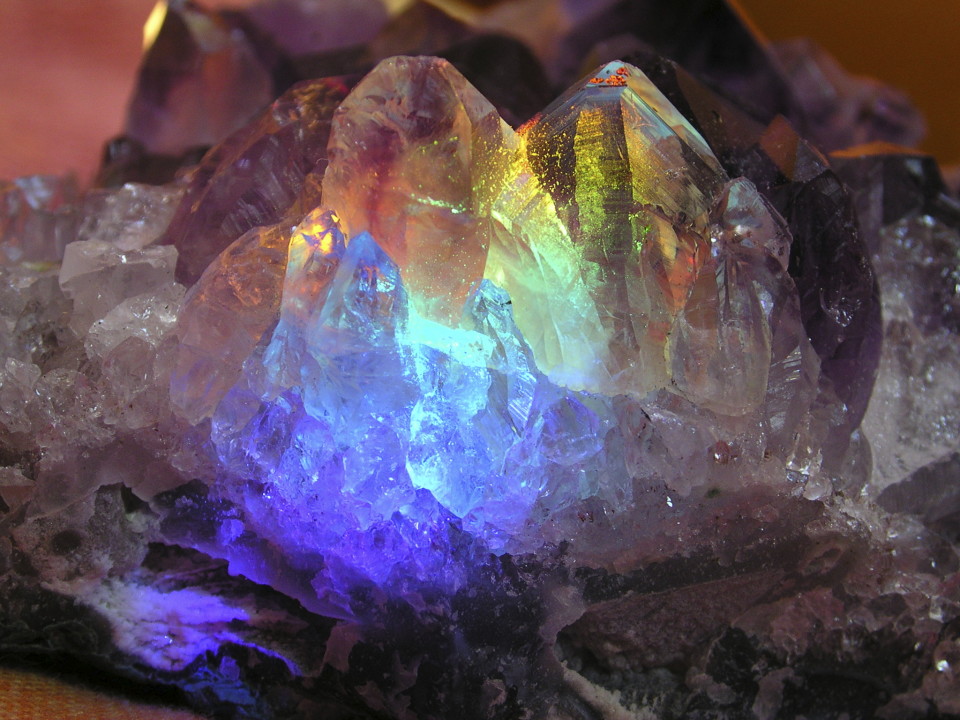
I discussed the art of Crystal Magic in a previous blog article, but I didn’t really focus on it as an important part of the energy model of magic and I would like to address those ideas here. Crystals of various kinds have been an integral part of the magic that I work for many years, but I haven’t emphasized in print their importance to me, what I do with them magically, and the role that they play in the workings that I perform. Anyone who would carefully examine my personal magical temple would find a number of crystals placed at strategic locations. These are not used as New Age props nor do they function as interesting but useless esthetic “eye candy.” They have an important functional use in the magic that I work, but that importance is only made possible because of the way that I have developed the energy model of magic.

I started using crystals in my magical workings back in the early 70's. This was way before crystals became a big fad in the New Age community some years later. The way that I discovered crystal magic is an interesting tale all by itself. So, I should tell this tale since it does deviate considerably from how crystals came to be used by adherents of the New Age.

What was my source of inspiration? I blush to reveal that what inspired me was a daffy movie I loved and celebrated which came out during that time (1974). It was the movie “Zardoz” (believe it or not), and I the first time I saw it I was quite stoned. (A few of my friends have also told me this tale about seeing the movie while stoned, so maybe it’s part of the movie cult.)


The use of crystals in that movie were quite futuristic, or perhaps even based on pure fantasy, since the AI computer system (called the Tabernacle) that empowered the “Eternals” living in their isolated vortex was centrally stored in a large crystal diamond, and each “Eternal” had a smaller version of that crystal planted in their foreheads to facilitate a conscious link to that computer system. They also had a crystal ring that functioned as a kind of AI interface. The Tabernacle became the repository of all their knowledge and even their memories and personalities, and when one of them died, they were brought back to life with all their memories intact. They also remained in a state of perpetual youth, a kind of haunting image of pretty young lithe “ambisexual” adults living with the eyes and jaded sensibilities of a people hundreds of years old. 

I was quite fascinated by the various astonishing ideas and visions depicted in that movie, but I didn’t make the connection between crystals and magic until I went through a period of taking LSD while performing magical experiments not long afterwards. The whole premise of crystal magic that I use today was based on what I saw when playing with multifaceted man-made crystals along with small ultra-bright flashlights, strobe and black lights. I saw the lines of force being stored in the crystal, and I could not only enter into the crystal, but could replay certain ritual workings collected in it. It was revelatory, and the insights that I gleaned from these experience became the basis to the methodology that I developed for my version of crystal magic. I can say that having learned to see into crystals in this manner, I have retained that visual ability. Needless to say, it was quite different than what the New Age passed off as “crystal work.”

Anyway, for me to state that the basis of my techniques of crystal magic were based on some very fascinating hallucinations induced by several acid trips is probably not something that anyone would declare as the source of magical ideas or insights. However, this is the truth of the matter, and sometimes strange experiments done in the spectrum of the highly irrational can produce amazingly great results. I don’t recommend either myself or anyone else using this approach to magical experiments at the present time, since I am now of an age that such experiments would represent a potential mental or physical health hazard. Still, my magical system was founded on the enthusiasm of youthful experiments, when such actions are acceptable risks in the delusional mental background of immortality and invincibility that haunts the young. There was a bit of the Zardoz “Eternal” in what I was doing back then. Thankfully, I am more cautious today about engaging in such crazy exploits, but I am no less curious or optimistic - that part of me hasn’t changed.  

Let us start by examining the basic elements of crystal magic that I wrote up six years ago (found here) so we can then examine the attributes of a “strong” energy model of magic and how it works. I am taking the portion of text from this article that specifically deals with crystal magic, since it was well written and helped to define what crystal magic is and how it should work. I associate the crystal in magic as representing the element of spirit, as far as the elemental tools are concerned. I think that this association is intriguing and gives considerable creative flexibility for the use of crystals in the practice of magic. (Note: I have made some edits on the following text to improve its readability and deepen what is presented.)

***

Spirit - Crystal or Stone - The quality of Spirit has some particular correspondences associated with it, and these are determined by the definition that Spirit is the unique joining of the previous four elements, producing a synthesis which is also their source. The crystal is uniquely qualified to fill this position, and has many useful and important magical properties. 

Crystals come in many different sizes, shapes, either naturally occurring or man-made; they have the variable qualities of hardness, cleavage, optical properties (clear, opaque, translucent, colored) and electrical conductivity. Some crystals have quite unique electrical qualities, such as quartz, which demonstrates piezoelectric phenomena (where mechanical stress produces electricity). Other crystals, such as germanium or silicon carbide, are used as semiconducting rectifiers, such as what has been used in the various layers of a computer chip. Crystals also exhibit the qualities of resonance and oscillation when a small current of electricity is passed through them (an anti piezoelectric effect). Thus, from a purely metaphysical perspective, crystals receive and store, unleash and vibrate or oscillate; these qualities make them uniquely useful in a magical context.

The basic magical premise of crystal magick is that a crystal can capture and contain the etheric or “fusion-like” energy that is produced in a magical ritual. This is particularly true when the ritual magician bases all of her workings on the prismatic ritual structure of the magnetic spiral vortex. Vibrating patterns of magical energy trace patterns within the crystal, and it can hold that energy indefinitely. That same energy can be retrieved or tapped by the will of the magician so that it can be replicated and projected into a magic circle for reuse. A crystal can accumulate the etheric energy tracings of many ritual workings so that over time it will house a representation of all of the workings that are performed in its presence.

So a crystal can act as a kind of magical memory receptacle, holding the energy until it’s needed or discharged by the magician. From a magickal perspective, crystals can be natural (hopefully, ethically harvested) or man-made. Each crystal has a unique magical effect depending on its shape, size, clarity, color, facet characteristics and whether it is natural, manufactured, or made from molded and polished, lead crystal glass. All of these crystal types are useful in ritual magick, and the only factor is the esthetic sensibilities and tastes of the magician. Cleaning a crystal in salt water will clear it of all influences, yet anointing it with oil or a liquid sacrament does just the opposite - empowering and emphasizing a certain event.

Crystals have the following qualities:

Collectors of magical power - not only do they collect the light frequencies of discrete magical workings, they can store them almost indefinitely, allowing the magician to retrieve either part or the full energy signature of a specific spell performed in its midst. (This can be done multiple times with the same specific energy signature. This would indicate that retrieval doesn’t necessarily discharge what is stored in the crystal.)

Emitters of magical power - crystals not only collect magical power, but they also can transmit that power as well. What is transmitted appears to be more similar to the “information” attribute of a magical power instead of actual magical energy. The energy signature is what is emitted from the crystal, and this seems to become an actual energy field when projected into a consecrated magical circle.

Processors of magical power - multiple magical workings stored in a crystal can be condensed averaged, summed and even multiplied. A magician can retrieve certain aspects or a ritual working to examine independently from the rest of the stored signature. 

Crystal magic as I employ it uses three crystals strategically placed in the magical temple, and these are used in a specific functional manner. These are:

1. Base Crystal or Collector - This is a large crystal, usually natural and consisting of many terminated points. Can be clear, smokey quartz, or of any color, as long as it retains some clarity, allowing light to pass through it. The collector crystal is kept either on or at the foot of the main altar. The collector is used as a kind of recording system for any and all magical rituals performed in the temple. It can recall any part of any ritual performed, recall a series of rituals in a working, or process the magical power collected to extract the overall meaning of a single or multiple workings.

2. Controller or Transformation Crystal - This is a small crystal that is worn around the magician’s neck on a necklace. The controller is a crystal that records the impression and energies associated with the individual magician. The controller can automatically or on command draw and direct power from the collector into itself for the magician to use at any given moment, regardless of the actual physical distance between them. The controller can be worn underneath a shirt or blouse when the magician is in the mundane world, allowing him/her to access and project magical power from the temple complex while far outside of its normal influence. When used during an evocation using both the energy and spirit models, it is called the “crystal of transformation,” since it assists the wearer to fully experience the domain of the spirit that is invoked. It helps to process the phenomenon of evocation so that it is instantly intelligible and meaningful to the magician.

3. Transmutar - this is a wand or stave that has a small crystal affixed to its tip. The transmutar wand is a specialized hybrid tool used in energy magic. It is the curious amalgamation of a wand and dagger, thus it can function as either one or both simultaneously. The transmutar wand can draw power into itself or send it out using either the controller or collector crystals. There is a strong connection between these three crystals and they function as a single unit when a magician wields them in a magic circle. The transmutar wand is used to project energy and information to a given target, make lines of force, invoke or evoke spirits, or even defend the magician from any hazards (just like the wand and the dagger).

The transmutar wand is also a powerful emitter, drawing magical power into itself and amplifying it into the temple confines or to a specific target. Because of its obvious nature, a transmutar wand is usually used in a temple or a grove, but it can be hidden on the person of the magician and used in the mundane world, like the controller crystal necklace. The transmutar wand is the instrument that is used by the magician to access the base crystal, recall previous energy structures, and re-emit them into the magick circle, condense them with other structures or even erase them.

How I achieve this interaction with crystals is through a process of employing sensitive touch and focused visualization projected into the crystal. Sometimes it helps to have a very bright LED with a very narrow focus or a LASER light source to aid this process. Strobe lights and black lights can also be used to access the contents of a crystal, if you have the ability to creatively visualize. Once a magician is able to readily sense, touch and visualize the magical energies stored in a crystal, it then becomes a natural part of his or her regimen.

***

Crystals and the Energy Model

The use of crystals in magic relies heavily on various premises established in the energy model of magic. Without a strong definition of the energy model then the whole basis of these techniques becomes meaningless. The media that is captured, refracted, processed and emitted from crystals is magical energy. The definition of magical energy has many different frames of reference, whether it is an actual energy unknown as of yet to science or representing something of a metaphor for a process that resides wholly and independently in consciousness. What seems to determine the amplitude of magical energy is more driven by the magician’s emotions and feelings than by anything that might be capable of being measured or controlled, such as capacitors, resistors and the like.

Since crystals also seem to store the information or the essence (signature) of a thing or process, one could also say that the information model of magic is also used by this powerful magical tool. Crystals are unique because as a tool, they straddle more than one magical model. The energy and information models are used, but then so is the psychology model, since one must use the “As If’ formula to actually make a crystal perform as required. If the crystal is a smooth ball or an oblong shape it becomes a window (or even a repository) into the Spirit World, thus additionally harnessing the spirit model of magic. The fact that crystals can bridge all of these models of magic individually or simultaneously makes them uniquely suited as the most excellent magical tool . 

While the belief in a collective magical energy field has been around since the beginning of human consciousness, being variously called Mana, Chi, Vital force, Life-Force, among others, the belief in individual based energy (or energy generated from a person’s body) is more recent. Added to the metaphorical layers of the meaning of magical energy or power are many of the characteristics of electromagnetism, even though such a borrowing is not accepted as fact by science. My opinion is that both individual and collective definitions of magical energy or power are useful and important, as well as the other aggregated metaphors that we use to describe something that is tangible to the senses but not empirical in the laboratory. One of the more mysterious attributes of magical power is that it seems to extend lines of force that connects everyone and everything into a holistic union. I saw this phenomenon early on when I was working magic as a youth, so it was for me not some Neoplatonic pipe dream but a real characteristic of magical power and magic in general. This would indicate to me that what I am experiencing and perceiving is more of a “collective” energy model, since it readily extends far beyond myself.

We are all part of the web of magical energy, and that allows for a certain interaction between individuals and even inanimate objects. I can still see these lines of force today, although it helps me greatly if the lighting is dim (indoors) or spectrally illuminated by moonlight or firelight (outdoors). Whenever I would connect with one of these lines of force I immediately felt a kind of link between myself and to whomever or whatever the line was connected. These lines of force also led to me realize that behind the individuality of everything there was a point where all lines converged. I realized then that in this interconnected web was a unified source, which I emotionally experienced as ecstasy or ultimate power. At that time I had never read any Plato and I was probably not up to reading anything so intellectual or complex. It was a natural experience for me, and one that I always associated with my energy model of magic.

Magical power is never static. It is always in movement. Even when I peer into my crystals to see the lines of force they are in constant movement. The prismatic energy fields that I experience when working energy based forms of magic are also moving, fluctuating, vibrating, pulsating and seemingly forever forming new connections and lattice structures or disappearing or dissolving old connections. When I concentrate magical power in my body, focusing it in my hands or feet, it causes them to feel the vibrations and pulsations of that energy. My hands shiver and shake, and my body moves, sometimes causing me to briefly dance so as to express the energy that I am feeling. Utilizing this model to directly “feel” and “experience” magical power in the body as an individual is even more heightened and amazing when working forms of sexual magic with a partner. This kind of energy based magic powerfully impacts the body, and it is there that the most fundamental of magical changes can be made.

I have already written quite a number of articles about the energy model of magic in my blog, and you can find an index for all 14 of them following this link.

Lines of force, geometric prismatic energy shapes, vortices, pylons, pyramids, gateways - these are some of the many magical energy patterns that I have developed and use with the energy model of magic. All of these qualities are perceived, recorded, processed and emitted through the use of crystals in a form of crystal magic. Crystals are just another magical tool, but they are associated with the element of spirit, and this makes them capable of working and channeling all four elements, including the union of the elements known as Spirit. Crystals are the quintessential element in the magician’s repertoire of magical tools. I have performed some of my workings using only a transmutar wand, dispensing with wooden wands, daggers, swords, and staffs. The crystal has an earth based attribute, particularly if it a natural crystal, and it also seems to be like a liquid frozen into solidity, thus emulated the earth and water elements. Dipping a crystal into a chalice of sacramental wine or touching a sacramental host assists it to capture the signature of that magical sacrament. This use causes the crystal to function as another tool type, and that is a magical reliquary - another topic we should discuss in the future.

As you can see, crystals are eminently useful to a magician, and they are a key instrument employed in my extended version of the energy model of magic.

Frater Barrabbas

Thursday, September 5, 2013

Basic Elements of Ritual Magick


Recently, there has been some discussion on the blogosphere regarding the importance of intention and will, or perhaps more accurately, the inflation of the importance of these elements. While will-power (initiative) and intention do play important parts in the performance of basic rites within the discipline of ritual magick, they are (of course) not exclusively important. These two elements are part of an overall package, and unless the whole package is known and understood, then all sorts of silly ideas about ritual magick can be entertained by the beginner.

In my previous two books, “Disciple’s Guide to Ritual Magick” and Mastering the “Art of Ritual Magick,” I believe that I have defined these elements but not in a concise manner. Going over what I wrote years ago has prompted me to revisit these basic concepts and attempt to write about them in a much clearer manner than I had previously in these books. I guess you could say that my thoughts, perceptions and my ability to write has improved to the point where I believe that I can now write a better and clearer set of definitions about the basic elements of ritual magick.

How I define intention and will-power regarding ritual magick is to understand them as important parts of the very beginning foundation of any kind of rite to make a change occur in material reality. Intention is important because it represents the plan for making something happen (although it is not yet implemented) and the will, as will-power, representing the desire and discipline to make something happen. Yet these two elements don’t trump the others and are seldom useful or constructive by themselves. In other words, I have never believed that intention alone can cause something to happen, and that will-power by itself can’t accomplish any kind of important achievement. There has to be a coordination between several elements and it’s important to know what they are and how to define them.

The key-stone to functioning as a successful ritual magician is to be empowered, and what I am referring to here is “self-empowerment.” So you might ask what is self-empowerment? It’s certainly a phrase that gets used a lot if you read books on magic, pop psychology and self-help. It is the opposite of helplessness, which is the usual state of being that most humans encounter at some point in their lives (often, but not always, at the moment of their death), and some people never seem to get beyond this state once their desires are thwarted. If we examine the definition of empowerment then I believe we will find the clues to understanding self-empowerment and how it relates to the practices of the ritual magician.

Looking up the word “empowerment” in the dictionary reveals to us that it has the meaning “to enable, to make able, give power, means, competence, ability, to authorize.” Power itself (in this context) means to do something, to act, to accomplish or achieve. In the context of ritual magick, empowerment cannot be given to someone. It must be earned by experience and personal achievement over time, and that’s why it’s called self-empowerment. A teacher can teach someone how to perform ritual magick, but the student must master the art by themselves and learn to be competent and have the assurance to succeed at gaining their magical goals. That can only be accomplished over time (usually years) and through many experiences (including failures as well as successes). Yet it is only the successes that build up personal magical empowerment, and that’s why a magician will focus on them rather than the failures; since the successes are what have given him the empowerment and certainty to continue the quest, and ultimately, to complete the great work itself.

Where self-empowerment is the key-stone, then discipline is the foundation. In order to be competent at something, one must practice in a periodic and regular manner. A ritual magician uses the cycles of the moon and the sun to partition her world and to fill a practical discipline with daily, weekly, monthly and seasonal rites and exercises. An old saying amply reflects this kind of activity - “Live by the Sun, love by the Moon.” What a discipline should contain varies from magician to magician, but it should have regular meditation sessions and periodic rites of spiritual alignment, including and particularly, godhead assumption. Based on the Lunation cycle, the magician should also regularly practice magical workings. The more experience that a magician has, then (hopefully) the greater will be her self-empowerment. These two elements work together, of course.

Within the foundation of the repertoire of practices of the ritual magician is the ability to achieve a form of ultra-conscious ecstasy. There are a number of different methods for achieving this state, and these can be facilitated singularly or in combination using breath control, trance, dance, mantra chanting, sacramental drug usage, sacred sexuality, bondage and discipline, or any other mechanism that achieves ecstasy. It is said that in magick, ecstasy is the key, and that is quite true; but ecstasy is used to push one’s self into the highest states of consciousness as well as exeriorizing or projecting magical power into the mundane sphere. The thing that all of these forms have in common is that they are achieved through the process of resonance. I define resonance as an iterative process that increases in frequency and amplitude until a climax is achieved. Even if a magician uses sacramental drugs, she must engage in some kind of iterative process to push the altered state into its highest expression.

All spell work begins in the same place, which is a desire or a need for something fueled by the imagination. From this the magician puts together an intention, which is a kind of plan of action. A wise plan for a specific end always has a greater overall plan behind it, so that is how the intention and purpose work together to forge a magical working. The intention is a kind of rationale for the desire and fantasy based result, which I call the objective, and it can be established by affirmations and self-promotion that engage one’s self-empowerment. However, if the intention does nothing more than this and there are no corresponding actions, then the intention will likely produce nothing. What makes the intention a truly powerful magical element is the joining of desire, affirmation, imagination, self-promotion, with actions, both magical and mundane. The most important thing that I stated about an intention is that it is a plan, and a plan should have magical actions and also mundane actions. It is also important to schedule your working for an auspicious time (phases of the moon) and determine deadlines for the results to appear, since this defines the proposed working within the boundaries of limits and forces one to take the initiative.

One further step in building up the intention is to translate the objective into a symbolic formulation. The easiest way to do this is to craft a sigil, but there are other attributes that one can use as well. For instance, often it is good to classify the objective in regards to an element or one of the seven planets, and then to find other attributes to identify the objective, such as color, perfume, incense, associated godhead, angelic or goetic spirit, etc. A sigil can additionally represent any of these attributes, such as the color of the ink or paint, the medium upon which it is inscribed (stone, parchment, wood, metallic disk, gemstone, etc.), and then blessed and charged with an incense, perfume and in the name of some aspect of Deity. I believe that translating an objective into a sigil is a very important stage in any kind of ritual magical working. Even if you are using a sigil or a character to help summon a spirit, adding a sigil for the objective to that the sigil of the spirit can further help to determine that goal in a symbolic manner. Minus a sigil, a magician then has to create a construct consisting of the attributes associated with the working, and often these are collected together and placed in a cache or medicine bag. I prefer to use a sigil to translate an objective into a symbolic form. You can find a whole article dedicated to sigil magic here.

Why is this item so important, you ask? Why must we symbolize the objective of a spell in some manner? There are two reasons. The first is to make it into the physical link for the spell, and the second is that it can be more easily acted upon during the symbolic manipulation phase of the spell. A physical link is a handy and succinct representation of the spell’s objective, and it becomes the magical carrier for the spell itself. A physical link is the bridge between the world of spirit and the mundane sphere, so it has an important task of representing the objective within the spirit world itself. 

Once these elements have been defined, we can move on to discussing the magical actions, or what would be called a working or an overall spell. A ritual magical working consists of two parts, which is the focusing of emotional forces and symbolic manipulation. It doesn’t mater if the magician is using the energy model or the spirit model; both models use these two elements equally. These actions are performed within sacred space and through a proper altered state of consciousness as established by a meditation session. As part of the self-empowerment, the magician may also employ a personalized attribute of deity within the working, such as that which is acquired through a godhead assumption. The more that a magician can do to bolster his own sense of self through a magically induced spiritual alignment then the outcome will be more potent. It is good to have the Gods on your side when performing a magical operation to acquire something.

So, the elements that have already been determined for a working before the working is actually commenced are those that involve the self and space (various preparations), alignment (god head attribution and/or assumption), defining and building the physical link, and establishing the intention and clarifying the objective. Additionally, the magician should have performed divination on the objective to determine its probability and explore the various associated mundane steps. Ethical considerations should also be weighed (during the divination process), and the magician should feel fully justified in performing the working. The timing of the working and choosing an auspicious date to perform the working is also determined well before the working is to be performed. 

Preparations regarding the self are forms of purification and meditation used to transition the mind from the mundane to the spirit world. Also, the space where the working is to be performed is also purified and made sacred, thereby taking it out of the mundane context. A circle can be used to establish a boundary line, and the area within the circle is sacralized with incense, soft illumination, conducive music, and aspurged with either lustral water (salt water) or florida water (water and perfume). Drawing the circle and establishing the cardinal directions are performed by the magician to establish a complete world within the domain of spirit. All of these preparations are performed in a thorough and methodical manner, leading the magician up to that moment where the magical operation will be performed.

As I stated previously, the actual magical working consists of the focusing of emotional forces and symbolic manipulation, in that order. The first step is to harness the passion and emotions that are the driver of the magical and mundane intention. If a magician feels ambiguous or lacks passion about a proposed magical objective, then whatever is done will be weak and likely ineffective. Conversely, the greater the passion that a magician feels about an objective, then the potential for success is greater. Passion is an emotional energy, and establishing a base of this kind of energy will help charge and empower the working. While it is not singularly important that the energy be given any kind of definition (some still think energy is just energy), I believe that defining and articulating the energy makes it more precise and capable of driving the process. The easiest way to define the energy is to use an invoking pentagram of a specific element, and to set these to the four cardinal points and then draw them to the center of the circle through a spiraling circumambulation (from the outer periphery to the center of the circle - a deosil spiral) .
   
Symbolic manipulation is where the magician uses tools and symbols to express a symbolic meaning or ideation within sacred space. Of course, setting or consecrating a magic circle and performing various other rites with tools, drawn devices (lines of force, circles, spirals, triangles, pentagrams, hexagrams, etc.), intoning incantations and words of power, and using various visualization techniques are all a form of symbolic manipulation. Aside from assisting in defining the base energy of the working, the operation of symbolic manipulation that is critical to a simple spell is joining the physical link to the raised energy (called empowering the link), and thus when the energy is so imprinted, to perform an exteriorization rite (thereby projecting the power to the actual objective outside of the circle).

Empowering the link is where the charged and consecrated sigil is brought into the center of the circle at that point where the power is fixed, and then an association is made between the sigil and the latent energy. At this phase of the spell the magician can visualize the objective and also the intention, including all of the mundane actions, and focus that into the power using his hands or tools. The accumulated magical power, which is the emotional passion associated with the desire for the objective, has now been imprinted with a clear intention and objective, and it is ready for exteriorization.

An exteriorization is achieved through resonance, and this can be accomplished through several different mechanisms. This could also be when the magician employs some form of ecstasy as a method of exteriorizing the collected and imprinted energy. I often use a widdershins spiral and a simple chant, and as I proceed from the center to the out periphery of the circle, I can feel the intensity and the stress of pushing the power increase with every step. Even the chant speeds up and increases in volume as I get ever closer to the outer circle. I plan this spiral so that I will only transcribe the circle three times, and at the end, I will project the power out of the circle with every bit of energy that I have. Sometimes the exteriorization is so potent that it causes me to fall to my knees in exhaustion.

As you can see in the example above, I have used the energy model to describe a simple spell. A magician could also use the evocation of a spirit (typically an elemental, planetary or goetic spirit) to achieve a material goal. In that situation the whole working would be orientated to performing the evocation, and then the intention of the working would be presented to the spirit to achieve, often with some kind of exchange. To perform this kind of working, the magician would have to be proficient with evocation, and that would represent a kind of working that would be somewhat more complex than what I have presented here. However, the use of a sigil that would symbolize the intention and the objective would still be fashioned, and this would presented or imprinted on the character, tool or sigil used to evoke the spirit.

The various stages that I presented above is called the master pattern of ritual magick, and there are seven of these stages. The master pattern consists of the elements of self, space, power, alignment, empowering the link, exteriorization and divination. You can find an article in my repertoire that amply covers each of these elements. As for divination, I am a firm believer that divination should be performed both before and after a working to ensure that the magician is fully informed at all points during the working. You can find an article outlining the master pattern of ritual magick here. I have also discussed these concepts more thoroughly in the article about sacred geometry in the energy theory of ritual magick, and you can find that article here.      

To recap what has been discussed in this article, I have proposed the following nine elements as important attributes that are found in a simple energy based working or spell as practiced in ritual magick. These nine elements are:

  • Self-empowerment and discipline - the competence to perform the working
  • Intention - plan, including magical and mundane actions
  • Initiative or will-power - desire to take action
  • Emotions, desires, imagination, passion - the basic magical power
  • Objective - goal
  • Physical Link - symbolized translation of intention and objective
  • Symbolic manipulation - magical and symbolic actions (performed in sacred space)
  • Altered states of consciousness and sacred space
  • Timing - an auspicious time for the working

As you can see, it takes a number of elements, an overall structure and emotional passion to achieve a goal through the art of ritual magick. Not one of these elements is exclusively important, although some of the elements might be either omitted or glossed over without destroying the effectiveness of the overall working. However, I believe that part of the discipline of ritual magick is to thoroughly develop and work each of these elements, since the more that is put into a magical working the better will be its potential outcome.

Frater Barrabbas

Friday, September 21, 2012

Thoughts About Using a Vault of the Adepti


Now that we have succinctly reviewed the definition and nature of the Golden Dawn Vault of the Adepti, and we saw how such a container device could be re-defined using prismatic energy geometry within the tradition of ritual magick, the real question is - what do you do with it? Is such an elaborate structure merely nothing more than something to awe and inspire a candidate for the Inner Order? Besides the fact that in the Golden Dawn this chamber is used to propagate the mysteries of the second order through the guise of the tomb of Christian Rosenkruetz. It could also be a place where Enochian Chess could be performed or some form of skrying magic (analogous to Enochian Vision Magick); but the uninitiated public are pretty much left to scratch their heads, saying: “So much trouble and expense just for a collection of elaborate initiation rites?”

Yet since I have managed to replicate this ornate magical container into a complex ritual geometry, I can now see many uses for this tool. I will spend a few paragraphs elaborating on this particular insight, keeping in mind that I am completely ignorant as to how the vault of the adepti is supposed to be used for magical purposes in the Golden Dawn.

How this magical container would be used in the Order of the Gnostic Star for magick and initiations is a completely different manner, and one that I do feel competent in stating here. Since the key number for this chamber device is seven, then it belongs to the provenance of the Hierophant of the second order, which is the seventh degree. While such a magical structure becomes part of the tasks and ordeal of the Hierophant, it can be used in the initiation rites for the fifth and sixth degrees, since these are to be performed by him or her for the benefit of the initiatory candidate. I would consider this use of the vault of the adepti to be optional, since it would add even more elaborate structures to an already intense initiation regimen. Still, for the Hierophant and his ordeal of mastering the Seven Planetary/Sephiroth Rays, building and using the prismatic geometry for the vault of the adepti is a critical task, or so I have come to realize.

I would name this newly discovered mystikon or chamber of the mysteries for the Hierophant and the 7th degree, the Vault of the Adepti of the Seven Rays. It’s theme would be associated with the mystical tomb of Hermes Thoth instead of Christian Rosenkruetz. In my opinion, these two personages are similar and analogous, but represent different time periods and mythic systems. I think that Hermes Thoth is more pagan and representative of the Hermetic system of magick, but that’s just my opinion. Also, these seven rays are not to be confused with the seven rays of Theosophy, since they are considered in the Order to be nothing more or less than a subset of the Ten Sephiroth. This is why I am associating them with the Sephiroth in my nomenclature to avoid any confusion. 

Some years ago I had completed assembling all of the rites and ordeals of the Hierophant, and these were divided into two overall categories; those that are worked with the number seven (as in the Seven Rays), and those that are worked with the number eleven (as in the sacred seven matrons and four patrons). I won't go into any detail about these two ordeals at this time, but the foundation of the ordeal of the Seven Sephiroth Rays was a rite called the Ritual of the Seven Rayed Star. What I realized after discovering that I could simulate the vault of the adepti using prismatic energy geometry is that it was a better and more complete foundation than what I had previously determined. I would need to insert this new ritual (when I get around to writing it) into the regimen of rituals used for the ordeal of the Seven Sephiroth Rays. It will make that ordeal more complicated, but it will also make it far more powerful. The newly formulated Vault of the Adepti of the Seven Rays can also be performed alone and outside of the ordeal (once it’s mastered) to perform some very valuable forms of magick.

So the question is what kind of magick is this vault of the adepti to be used by the fully vetted Hierophant of the Order of the Gnostic Star? First of all, considering the number of elements packed into the ritual structure (40 x 7 = 280) and that it incorporates the Qabalah, Astrology and even a form of planetary alchemy, it represents the full spectrum of all symbols associated with the Seven Rays. It is, in fact, a kind of magical machine, which can be used to set any combination of symbols to produce some kind of magical effect. We can also consider that those symbols are also associated with numerous correspondences, including hierarchical lists of Godheads, angels, demons, earth spirits, and any number of other spiritual entities.

A magical machine exemplifies the magical concept of “Thought becomes form, and form becomes thought.” This concept is a hallmark of the Hermetic path itself (as we shall see below). The focus of a magical machine can be on the Inner Planes to acquire knowledge and insights, upon the self to effect a powerful form of self-transformation, and it can be focused on the material world to bend reality and make changes. It can be used actively to project magical power and it can be used passively, to perform divinatory operations. It is also a kind of mystical chamber where the themes of death, immutability and even regeneration are expressed.

In the case of the Golden Dawn vault of the adepti, the premier mythic personality is Christian Rosenkruetz; for modern pagans, that personality would be Hermes Thoth, Thrice Greatest. The tomb is also a place outside time and space, since within it, the body of the mythic personality is not necessarily considered dead, but only in a kind of deep sleep or stasis. Not only is the sleeping magus of great importance, but so is the knowledge contained within the vault itself. In the case of Hermes Thoth, that knowledge would be ensconced within the Emerald Tablets. The aphorism of “That which is above is like that which is below, and that which is below is like that which is above..” encapsulates the secret knowledge of the power and majesty of the magical machine. Through an application of its powers and capabilities, anything can be accomplished.

So learning how to deploy this very important ritual system into the body of the ritual ordeals of the Order is critically important. I am glad that I discovered this new piece associated with the Hierophant degree of the Order, but it does make me wonder what other pieces are missing from that which I have already determined and written up. Looking over the list of rituals associated with the Seven Rays, I had always felt that the overall structure was quite weak and incomplete. Since I didn’t have any additional insights as to how that ordeal should be strengthened, I didn’t give it much more thought. Now, several years later, I have determined another very important piece, and it does make that ordeal much more powerful and comprehensive.

One other thing that haunts me as I go through this ordeal of discovery, seemingly a constant and never ending process, is that I originally develop a series of rituals to perform for a given ordeal or to achieve a certain end, and then some years later discover that something was missing or incomplete in that work. This doesn't happen with every ordeal that I have developed, but it has happened often enough to make me a little worried about the permanence of my work. I have often wondered why this is so, but I do realize that all creative minds execute their creations in erratic waves, and later on when they discover new ways of doing things, that knowledge is often applied to that past work. Creative work is forever ongoing and doesn’t end (hopefully) until the artist finally sheds his or her mortal coil and ceases to work from that moment onward. Others might pick up the torch and pursue it, and over time, might even add more realizations and creative inspirations to the work. This is much more possible and realistic when considering such fluid endeavors as occultism in general, and specifically in the arenas of ritual and ceremonial magick.

It is my hope that others will invest themselves with the lore of the Order and perhaps keep it moving forward even after I have passed from this world. My only hope is that the lore that I leave behind has no glaring holes left in its array of ritual workings, and that the work moving forward is the invention of new ordeals and ritual workings instead of fixing what I failed to complete.

Frater Barrabbas